https://ukonward.com/reports/building-consent/
Onward, Onward is a UK centre-right think tank developing bold and practical ideas to boost economic opportunity, build national resilience, and strengthen communities. 1200627
Onward, Onward is a UK centre-right think tank developing bold and practical ideas to boost economic opportunity, build national resilience, and strengthen communities.310310
Achieving change is very difficult when it imposes concentrated costs on a group of people who have the power and motivation to resist it.
When the Meiji Government came to power in 1868, they wanted to turn Japan into a centralised, industrialised, and fiscally modern state that could hold its own with the great powers of the West. One of the many problems they faced were the samurai, who received expensive and hereditary stipends that constituted over a third of government expenditure. The samurai strongly opposed the ending of these stipends, which were their primary income, a resistance which had teeth because of their monopoly on violence as the traditional warrior class. Instead of going to war with the samurai, the Japanese Government bought them out by replacing these stipends with government bonds, thus avoiding mass expropriation and an ensuing civil war, and turning their expensive liabilities into a manageable public debt.
The lesson of the Meiji Government’s approach is that making these highly affected groups the key beneficiaries of a change can make that change possible. That is how land readjustment, a mechanism that allows fragmented land to be pooled, re-planned and re-plotted, works. Land readjustment attempts to reward those who are most supported by a proposed development – those whose land a scheme involves – by sharing the resulting value uplift of that development with them.
The system of land readjustment, as proposed by this report, flows from the twin principles of consent and mutual benefit, aiming to give those who stand to lose the most from a development good reasons to support it. It is also a proposal that seeks to treat those who might oppose a development as rational people with real concerns who can be negotiated with.
This timely exploration of the principles of land readjustment is essential reading for policymakers considering the challenge Britain faces in delivering the homes and infrastructure it needs.
– Lord Banner KC
Executive summary
This paper proposes the introduction of land readjustment to the UK, a land assembly mechanism in use in many other countries. The UK currently relies on two other tools to deal with the challenges of assembling land for development: negotiated sales and compulsory purchase. But both of these have their drawbacks as well as advantages.
Negotiated sales are by nature fragile. A single holdout landowner in a key location, without which the development cannot proceed, can collapse a scheme by demanding a disproportionately high price or simply by refusing to sell. Compulsory purchase, while sometimes indispensable, is slow and legally fractious. As a form of expropriation, it must also be used sparingly. Land readjustment can be integrated into our system as a third way between these two tools, less fragile than negotiated sales and more democratic than compulsory purchase.
Land readjustment means that multiple owners, working with a developer, can pool their plots so that their land is developed as a whole. After development, that land is redistributed back to owners in smaller but more valuable plots. These plots are smaller because some land is retained by the developer to sell as a profit and because some is necessary for new infrastructure, like parks or a new road system. To go ahead in the first place, a land readjustment scheme must have the support of a supermajority of landowners who own a supermajority of the land in question.
In this paper, we demonstrate how a land readjustment scheme might unfold in the UK using the example of Park Royal, an excellently located industrial area in London. And we give further insight into how land readjustment is already at work in other jurisdictions with examples from Japan and Spain.
Introduction
Land is often divided into a jigsaw of small, irregular plots, each with its own owner. This fragmentation poses a major obstacle to development and existing tools to pool such land and permit development on it are inadequate. Projects are particularly susceptible to collapse by a small number of holdout landowners.
This paper describes the issue posed by fragmented land and outlines how land readjustment, a globally tried and tested urban planning tool, can help develop such land in the UK. Land readjustment allows multiple owners to pool their plots so that land can be redeveloped as a whole, before being redistributed back to owners in smaller but more valuable plots. There are two key principles at the heart of land readjustment and of the version this paper proposes. First, is that a large majority of the affected rights-holders, be they freeholders or leaseholders, must support the development. Second, the value created by that development is fairly shared back to those rights-holders.
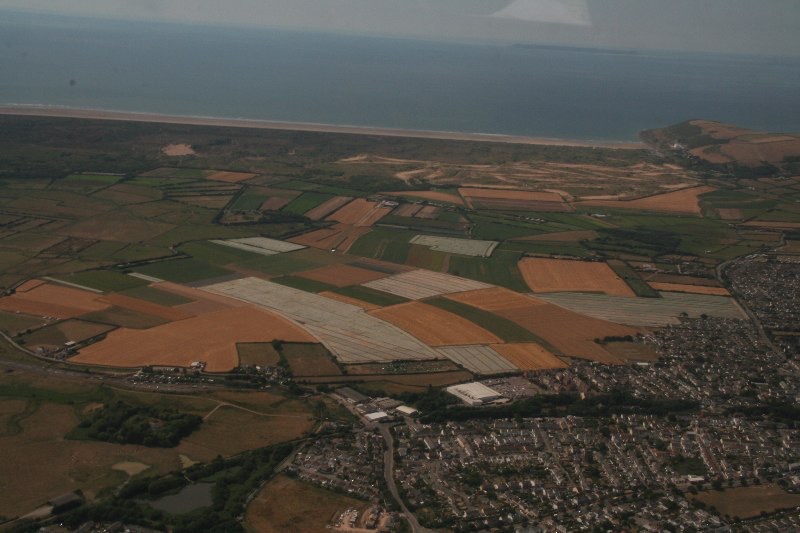
Source: Google Earth
As one walks through the English countryside, like the stretch of Cornish coast above, one crosses field boundaries that squiggle and snake. Thin strips of land sit alongside squat rectangles with bulging sides. One field here curves while its neighbour fans out like a skirt. This patchwork is the result of the piecemeal clearance of heath and woodland by neolithic and medieval farmsteads, of the solidifying process of enclosure, and myriad other events from the parcelling out of land between siblings to the selling off of strips to raise dowries or pay debts.
Similar fragmentation characterises many significantly more built up areas. Fragmented and yet underdeveloped land is particularly common in former industrial areas – for example where streets and plots have evolved around long-vanished rail lines, depots and estates – and at the suburban fringes of cities.
The complexity of these often well-located pieces of land now constrains development. Redeveloping these areas requires assembling numerous owners, coordinating the construction of infrastructure, and negotiating with landlords who are prepared to hold out indefinitely for a better deal.
We have been in this situation before. The legacy left to us by the open field system, a medieval feudal farming system, was highly fragmented land burdened with a complex web of rights and ownership. The end of the open field system in England was achieved by what is easily recognisable as a type of land readjustment. This was crucial in unlocking land for more productive uses as the Industrial Revolution was beginning. In fact, in the eighteenth and nineteenth century, Parliament was extremely active in using its powers to assemble land for development. Every major railway was authorised by its own Act and given the power to assemble the land it needed and turnpike trusts and canal companies were given statutory powers to purchase land and to organise new infrastructure.1
To address the challenges of fragmented land today, this paper sets out: how land readjustment works and our history of it; how modern land readjustment works in other countries; and how a revived UK version could unlock development in what are now highly challenging sites.
The challenge of fragmented land
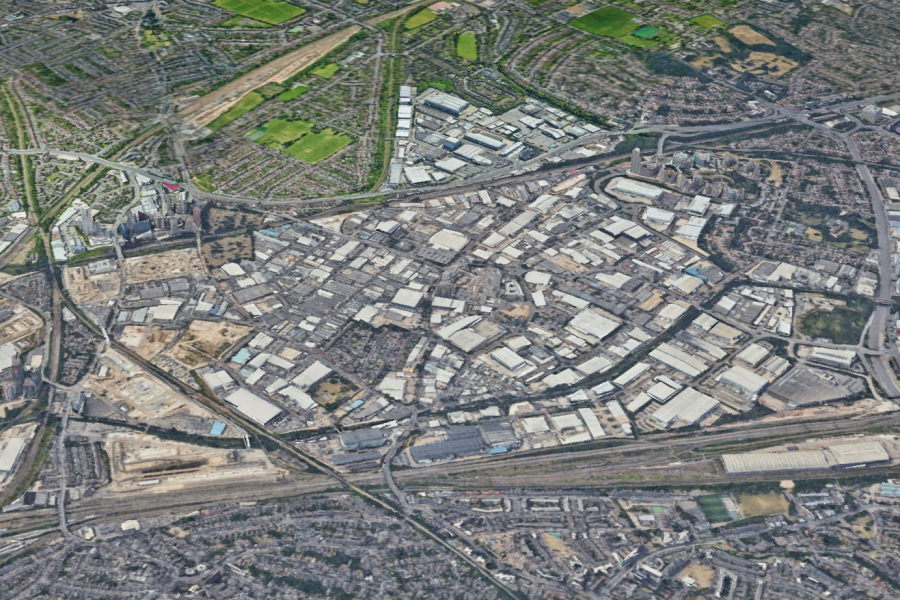
To understand the challenge that land with fragmented ownership poses to development, consider the example of London’s Park Royal, pictured below. Though in easy reach of stations on the Piccadilly and Central lines, it consists mainly of warehouses, with an incoherent road pattern that is the legacy of attempts to accommodate now defunct rail lines and depots. Park Royal is a very valuable piece of land. A great number of homes could be built there, helping to ease London’s acute housing shortage. If the sections of Park Royal within a ten minute walk to a tube or train station alone were developed to Paris-level densities (400 dwellings per hectare), then 135,000 new homes could be built.2 But to accomplish that, a would-be developer would need to consolidate Park Royal.
Source: Google Earth
The alternative, redeveloping just one plot in the area, is much less desirable, both to developers and planning authorities. This is not only for reasons of fixed costs, economies of scale, and viability, but also because of infrastructure and access for the small strip of homes that might be fitted onto a single plot as it exists now.
Consider also that some vital pieces of infrastructure require odd bits of land to be assembled. To build a new road through Park Royal, connecting it better to other parts of London, a long thin piece of land must be acquired that will doubtless cut through the existing properties and land of many different owners. A similar problem is presented by other major bits of infrastructure that must be built.
Existing tools are inadequate
To assemble the land, the would-be developer of Park Royal has two options available: negotiated sales and compulsory purchase.
Negotiated sales
Negotiated sales mean that a developer – or a public body, if the development is being coordinated by a development corporation or a council – must negotiate a deal with each landowner separately. If the pictured area of Park Royal was to be redeveloped, it would require the developer to successfully: establish who the owner is of every single bit of land; make contact with that person or entity; and persuade that owner to sell them that land for a price that is not so high that it makes the entire development project economically unviable.
Negotiating sales on an individual basis in an area like Park Royal, where there may very easily be over forty owners, will take a long time. But it also means that a small number of holdout landowners – and in some cases just one – can collapse an entire project. For example, a landowner who owns a large warehouse in a crucial central part of a development may refuse to sell. Or a small group of landowners in certain key areas within a proposed development, knowing their land is key to that development’s viability, may hold out for so high a sale price that a developer cannot buy them off without making the venture unprofitable for themselves.
Compulsory purchase
This brings us to compulsory purchase, which is currently the UK’s primary planning tool to deal with holdout landlords in developments of regional or national significance. A Compulsory Purchase Order (CPO) allows certain public bodies (such as local authorities and government departments) and some private companies with statutory powers that run essential infrastructure (like airports) to purchase land without the consent of the owner, when it is in the public interest to do so. A high profile recent use of compulsory purchase is in order to secure the land necessary to build HS2.
Compulsory purchase is expropriation and there are a number of safeguards upon it. For a CPO to be compatible with the right to property under Article 1 of Protocol 1 of the European Convention on Human Rights, as applied to UK law by the Human Rights Act, it must meet a legitimate public interest test and strike a fair balance between that public interest and the rights of affected property owners. Government guidance on that public interest test specifies that local authorities must show a “compelling case in the public interest”. CPOs must also be approved by the government via the relevant Secretary of State. The affected owners must be compensated so that they are not financially worse off than if their property had not been compulsorily purchased. Finally, the affected owners are able to object and have the proposed CPO independently adjudicated.
Even with these safeguards in place, compulsory purchase remains a way for the government to legally violate private property rights in the aid of what it judges to be the greater good. As a result, it is unpopular and should be used sparingly. Furthermore, the Government’s Planning and Infrastructure Bill will remove the safeguard that a local authority’s CPO must be approved by a Secretary of State.
Councils must often turn to compulsory purchase to assemble land in complicated multiowner brownfield sites. But for most local authorities, the process is very slow and extremely resource-intensive. The challenges of fragmented ownership, title constraints, viability tests, hope-value compensation and legal risk mean that CPO is treated as a last resort. There is a mismatch here: being able to assemble fragmented land for development is very valuable, but the power that is supposed to allow it to happen where there is a compelling public interest is excruciatingly difficult.
Our proposal: land readjustment
What is land readjustment?
Land readjustment is a legal mechanism that allows the various owners of a fragmented area of land to pool that land so that it can be developed as one. Currently, valuable areas on suburban fringes or in complex urban areas like Park Royal can be very challenging to develop because of fragmented ownership. Land readjustment, an urban planning tool that has been in use in countries all over the world for decades, offers a third way to realise such developments.
England’s history of land readjustment
“Common field arable usually lies, respecting the lots of individuals, in so scattered and divided a state, that every operation of tillage, harvest…is carried on at an expense considerably greater than in enclosures…” – Arthur Young, General Report on Enclosure (1808)
England previously developed a highly successful version of land readjustment in response to difficulties not unlike those we face with fragmented land today. Well into the nineteenth century, parts of rural England were owned and worked under the medieval manorial open-field and common-rights system, affected by a tangled burden of rights and duties that impeded development.
In terms of arable land, this meant fields that were physically divided into small strips. A field might be owned by a single freeholder but parcelled out into strips, each farmed by a copyholder with the customary right to work that land. Or, a single field might comprise strips owned by and farmed by various freeholders, with some strips leased out, and others farmed by copyholders though still owned by a freeholder. Similarly, pasture land was often grazed under the ‘stint’ system.3 A stint provided how many animals a local freeholder could graze on the piece of land in question and was generally attached to a particular tenement and were heritable. In some parts of England, stints or fractions of stints could be sold or traded separately.
The Great Field in Braunton, Devon. One of the very view surviving examples of the open field system in the UK today. Source.
This system could be inflexible and acted as a restraint on economic development. A stint-holder could not unilaterally put the land their animals grazed on to different and more productive uses without the consent of others who also held stints over the same piece of land. Scattered arable strips also impeded development and change of use, as any reorganisation required numerous small rights-holders to come together and agree.
Efforts to reorganise such land, known as enclosure, were often carried out informally by local agreement. But after the Glorious Revolution of 1688, Parliament became significantly more active and so took on a much greater role in this process of land reorganisation.4 From the late seventeenth century, freeholders and small rights-holders began to respond to the problem of land with severely fragmented ownership by coming together to petition Parliament to reorganise the rights to specific pieces of land. As with modern land readjustment, a petition to reorganise a piece of fragmented land required the consent of a supermajority of the affected landowners to succeed, with a necessary threshold of somewhere between 75% to 80% of landowners by value.5
If successful in their petition, Parliament would pass a private Act permitting the reorganisation and development of the land and appointing commissioners to oversee it. The commissioners were charged with surveying the land in question to clearly establish who had what rights over it, deciding how the consolidated land should be thus shared out, and developing new infrastructure like drains or roads.6
The General Inclosure Act of 1801 standardised much of the content of these private Acts, but it remained the case that every enclosure required its own private Act of Parliament. The General Inclosure Act of 1836 made it possible to enclose land without a private Act, as long as two-thirds of affected landowners both in number and land value consented.7 Under the Inclosure Act 1845, the enclosure process was streamlined further and individual private Acts were replaced with Provisional Orders that were confirmed by Parliament in bulk.
In this way, Parliament was able to dissolve the impediments of the common field system on demand from those it directly hindered, reorganising the rights over that land and giving individuals new rights over particular bits of land. This process of land readjustment was an “essential prelude to the Industrial Revolution”.8 It meant that commonly held agricultural land could be turned to new uses with new infrastructure, with housing and industry springing up where before only grazing or farming had been permitted.9 The difference even in agricultural terms between enclosed and open field land was highly observable. In an 1808 report for the General Board of Agriculture, agricultural economist Arthur Young wrote that the parish of Childersley, despite sharing “perfectly similar soil” with the neighbouring parish of Hardwicke, was significantly more productive than Hardwicke in terms of wheat, barley, oats and beans.10
Just like the modern land readjustment that takes place all over the world, this organically developed system was a way of consolidating highly fragmented land and allowing it to be put to more productive uses. Just like modern land readjustment, it required the support of a supermajority of the landowners affected to take place. And again just like modern land readjustment, it compensated those with a prior interest in the land by giving them new plots.
How could land readjustment work in the UK today?
Section 5 explains how land readjustment works in two case study countries, Japan and Spain. But first, it is helpful to summarise step by step how the land readjustment works in general, which we illustrate with the example of Park Royal.
Park Royal and land readjustment: a hypothetical case study
The Mayor of London, looking for ways to densify and make better use of land in the city, asks Ealing Council to look into developing Park Royal. The various owners of Park Royal each possess only a small piece of land in the area, perhaps a warehouse or two, situated on a higgledy-piggledy road network.
Ealing Council knows that Park Royal could be much more productively used than it is now. Land could be assembled to permit the development of a data centre, or the area might instead host new homes, within easy walk of the local tube station. But Ealing’s assessment is that the process of development would be slow and uncertain (using negotiated sales) or slow, controversial and legally fraught (using CPOs).
Many of the Park Royal landowners themselves know that their land has great development potential. But they face a collective action problem. Each of their respective bits of land are near other warehouses, just as unsightly as their own. It makes little sense to attempt to develop their small, oddly shaped parcel of land with homes, right in the middle of an industrial estate. No developer approaches them with such a proposition.
A new way forward emerges when land readjustment is introduced into the UK.
An area is designated and approved as a candidate for land readjustment. For an area to be eligible for land readjustment, it must be proposed as such by the local council and then approved by the Secretary of State for Housing, Communities and Local Government. Ealing Council proposes Park Royal be designated and it is approved for land readjustment by the Secretary of State.
A land readjustment scheme is drawn up. A developing agent, which can be a private or a public entity, is appointed by Ealing Council. The agent draws up a land readjustment scheme for Park Royal. The scheme proposes replotting the land, giving it a new road network, and developing it with homes or perhaps new infrastructure. If homes are proposed, the plan is likely to include amenities such as parks.
That scheme is voted on by the affected landowners and can only go ahead if approved on a supermajority basis. This proposal is put to Park Royal’s landowners in a ballot. The scheme will only happen if a supermajority of landowners owning a supermajority of the land vote in favour of it. This democratic system prevents a large number of small landowners forcing a landowner with a large amount of land to develop. A minority of Park Royal landowners strongly oppose the scheme and do vote against it, but ultimately a supermajority of landowners who own most of the land vote in favour and so the scheme is approved.
The scheme receives planning permission. The developing agent submits an application for planning permission to Ealing council and an environmental impact assessment if required. Approval from the Building Safety Regulator, if applicable, is also sought.
The approved area is redeveloped. The agent redevelops Park Royal. This includes knocking down existing warehouses and buildings to impose a coherent new road pattern and to create regular plots. The development will include the improvement of the area’s infrastructure in line with the approved plan.
The plots are shared back out to landowners but a percentage is retained by the developer. Now that the development is complete, the new plots are shared out to Park Royal landowners in proportion to what each contributed to the scheme. The Valuation Office Agency, which already exists and specialises in property valuation, assists in making sure that the plan gives owners back plots that are proportionate to what the land they contributed to the scheme. The plot of land each landowner receives is not necessarily in the same area where they had owned land before, and is also smaller than that they had because of space taken up by new infrastructure and because a portion is retained by developing agent to sell and so make a profit on the scheme. Yet though smaller, these new plots are much more valuable to the landowners. This is because, regularly shaped and now located with new and improved infrastructure nearby, they are ideal to be sold on for further development.
Landowners are now likely to sell their land on. The landowners are now likely to sell their plots, thereby realising the value uplift that their supermajority vote facilitated.
A third way between negotiated sales and compulsory purchase
Land readjustment sits between negotiated sales and compulsory purchase as a third way planning tool, more democratic and less intrusive than compulsory purchase and yet more efficient and less fragile than negotiated sales. Currently, the development of a fragmented area of land can be stymied by a small number of holdout landlords who, by refusing to support development, can collapse a whole project, even when the majority of landlords are in favour of it. Faster than individual negotiated sales, land readjustment allows landowners to negotiate and realise value uplift as a bloc. No single landowner can act as a veto player because if a supermajority of landowners who own a supermajority of the affected land support a scheme, it can go ahead.
But even under this system, a holdout landowner who votes against a land readjustment scheme but is overruled by the supermajority will be better off than if a CPO had been deployed against him. If his land had been compulsorily purchased, the holdout landowner would only have received cash compensation equivalent to his land’s market value. But because his land is part of a land readjustment scheme, the holdout landowner not only receives back a physical asset at the end of the development, he receives one that is worth more than what it was previously. This is reflective of how land readjustment allows urban planners to share the value uplist of development with those it asks most of, giving those people an incentive to cooperate in the creation of better amenities for all. These key differences between land readjustment and expropriative tools like compulsory purchase mean that land readjustment projects are much less likely to be held up by legal challenges, for example by challenges under Protocol 1, Article 1 of the ECHR.
Further positive data is provided by estate regeneration, to some extent a relative of land readjustment that is already working well in the UK. Estate regeneration concerns the development of low density post-war social housing in high-value areas like London. Under a regeneration scheme, an estate is re-developed only on the basis of a ballot of residents. If a proposed regeneration scheme wins the supermajority support of the residents, it goes ahead. In return for supporting the development, residents receive a new and much improved home and the developer is even able to add new social housing to the estate.11 Developers are motivated to offer to undertake these schemes because the regeneration creates additional homes that they can sell at a profit. Between 2018 and 2024 alone, residents have voted in favour of forty estate regeneration schemes in London, demonstrating the willingness of tenants to support a scheme that allows them to share in the benefits created by development.12
International case studies
Japan
In 1923, three strong earthquakes hit Tokyo in the span of around seven minutes. More than half of the city was destroyed and tens of thousands of people were killed in the quakes and the fires that followed. Land readjustment, which had already been used in Japan to consolidate farm land, was deployed on a large-scale to rebuild Tokyo. After the Second World War, it was again much used to rebuild Japan’s cities and in 1954 the government passed the Land Readjustment Act, systemising how land readjustment worked across the country. In addition to post-disaster rebuilding, Japan has also used land readjustment to develop new towns, regenerate urban districts, and build important infrastructure like railway stations.13 As of 2003, land readjustment has been used to develop roughly a third of Japan’s entire urban area.14
Step by step, this is how land readjustment works in Japan15:
An area is designated for land readjustment by a municipality or prefecture. This authorises the area for land readjustment but does not compel it.
A body is created to deliver the land readjustment project. The 1954 Act allows for several different types of delivery bodies to be created or brought into to manage the project:
A Land Readjustment Association, formed voluntarily by landowners and leaseholders. This is the most common delivery body;
The municipality or prefecture, often used for post-disaster reconstruction or new-town development;
A private corporation, authorised by the prefectural governor where public or association methods are impractical;
The Urban Renaissance Agency, for complex or multi-jurisdictional urban projects.
If the land readjustment project is government-led (by the Urban Renaissance Agency, the prefecture or the municipality) then it can proceed without the affected owners and leaseholders’ consent to the project. However, in practice, projects do not go ahead against substantial opposition. If the project is led by a Land Readjustment Association – as most are – then a proposed scheme must have the support of at least two-thirds of the affected landowners and two-thirds of the affected leaseholders, each representing at least two-thirds of the affected land area, in order to go ahead.
The delivery body creates a project plan, outlining how land parcels will be reorganised, how much land will be contributed for public use, and how costs will be financed through the sale of reserve land. The plan must be approved by the prefectural governor, unless the project is being delivered by the Urban Renaissance Agency in which case the Minister of Land, Infrastructure, Transport and Tourism must approve it.
The area is redeveloped according to the plan.
The replotted land is shared back out to landowners, each of whom ends up with a smaller but more valuable plot than what they owned previously. Where necessary, cash equalisation payments to a landowner can be used to correct discrepancies in the value of their new land in comparison to the old. The only land not shared back to landowners is that which now hosts public infrastructure and that which is sold by the delivery body to cover its costs.
The Misato Chūō land readjustment project
In the 1990s, the Japanese government approved plans for a new express train that would connect Akihabara in central Tokyo with the Tsukuba Science Park. The new line would pass through and build a new station at Misato, an area on Tokyo’s northern fringe with a mix of farmland and suburbia.
Recognising that this development would give the area superb transport links straight into the heart of Tokyo, Misato’s municipal government proposed designating the land around the new station for land readjustment. The proposal was approved by the Saitama Prefectural Government, which holds statutory authority over such designations.
Local landowners then together formed a Land Readjustment Association – the Misato Chūō Land Readjustment Association – which became formally established once the legally required two-thirds of landowners representing two-thirds of the land area had consented, and its founding documents were endorsed by the Saitama Prefectural Governor. The project covered about 115 hectares of farmland surrounding the future station, coordinating the replotting of roughly 3,000 parcels of land. Landowners contributed around 35-40% of their holdings to be used for public facilities and for reserve land. The project was majority financed by reserve land sales, but it did also receive government subsidies towards the costs of significant new infrastructure, like major roads.
Roads, sewerage, parks, and a community centre were laid out in advance of the railway’s 2005 opening, and existing buildings were either relocated or integrated into replotted parcels. Upon completion, each landowner received a smaller but more valuable plot, and cash equalisation payments to ensure that gains and losses were balanced across participants. Average land values hugely increased, from about ¥151,000 per m² before the project to ¥295,000 per m² after completion (an increase of roughly $1,700 per m² to $2,600 per m²)16, while the district gained schools, shops, and mid-rise housing linked directly to Akihabara in under 30 minutes. Today, the train services that run between Akihabara and the Park carry over 390,000 people daily, with many passengers boarding and alighting at Misato. 17
The Spanish region of Valencia has developed a very different model to Japan’s, forced to innovate after initially struggling to make the national land readjustment system work well. Under the reparcelación system that Spain first introduced in its 1956 Land Act, an area could be designated as a ‘developable’ for land readjustment by the local municipal plan. This designation gave landowners in that area development rights. But it also gave those landowners obligations: if they were to take advantage of the designation and redevelop, then they must also finance infrastructure and cede land for public uses. However, the land readjustment process introduced by the 1956 Act was burdensome and demanding of landowners.
In order to actually begin land readjustment and take advantage of their development rights, the Land Act required landowners to form an association called a Junta de Compensación. The formation of the Junta plays the role that the ballot stage does in the Japanese land readjustment system: the Junta could not be formed unless landowners owning at least 60% of the affected land agreed to participate. If this threshold was reached, the remaining 40% of the land was automatically incorporated into the development scheme, whether or not the landowners consented.
Once created, the Junta’s first job was to draw up two planning documents, one replotting the area and one making provision for new infrastructure and how it would be financed. Under the act, these plans would then need to undergo public consultation before being approved by the municipality. Pending the approval of these planning documents, the land would then be developed, the plots shared back out to landowners, and the land set aside for public use ceded to the municipality for development.
Most small landowners are not developers and have no developing experience, but the land readjustment process introduced by the 1956 Act relied heavily on landowners to lead on the process and take major decisions. That meant landowners had to do the work of establishing who owns what bit of land in the designated area and creating a plan for replotting and redistribution.
With few land readjustment projects initiating or completing, the Spanish government responded by revising the 1956 Act in 1976 to introduce the role of the agente urbanizador: the urbanising agent. The agent’s role was to redistribute the replotted land and create new infrastructure as part of the redevelopment. This relieved landlords themselves of the need to negotiate with one another and draw up plans themselves.
However, while an improvement on the previous system, urbanising agents struggled to successfully negotiate with landowners, over whom they had little leverage. As with the typical negotiated sales process, individual landowners were often motivated to delay negotiations, holding out for the offer of a better plot or simply preferring not to cooperate with the land readjustment scheme at all. Agents had no way to compel landowners to cooperate or negotiate and so often came to an impasse.
In recognition of this problem and the subsequent dearth of land readjustment projects, the region of Valencia made several changes to its land readjustment process in 1994, including:
Urbanising agents became able to get municipal approval for forced land readjustment if landowners refused to cooperate.
The use of an urbanising agent was made mandatory and the selection of agents through public tender became mandatory.
Would-be developers now competed in cost, quality and delivery times to win tenders to develop land in Valencia. Replacing amateur small landowners as the driving force behind readjustment projects, these professional developers could then negotiate with landowners knowing, knowing that the municipality could step in to break the veto of a holdout landlord. No more could certain landowners stall a project in the hope of forcing a better offer from the urbanising agent.
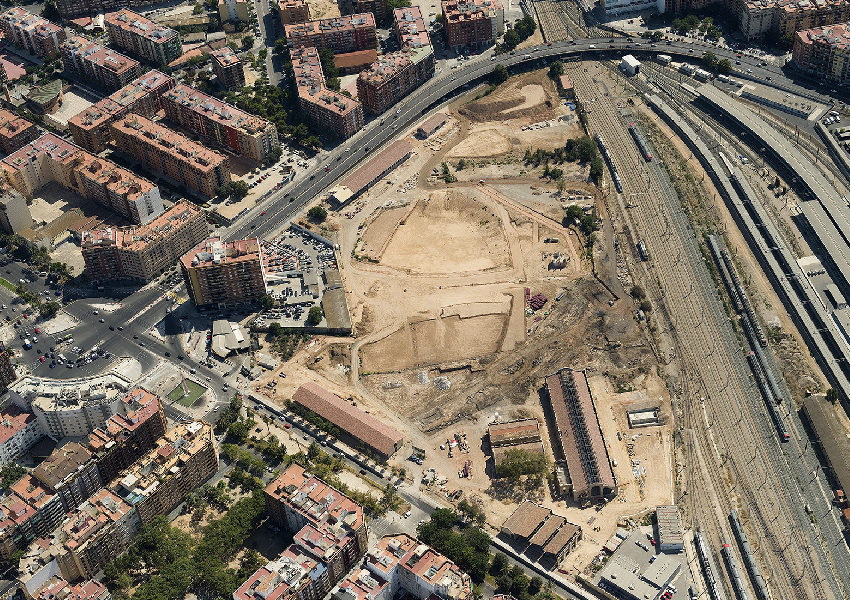
A Valencian brownfield site in 2007. Source. The same brownfield site pictured above after undergoing land readjustment. Source.
The effects of these changes were dramatic. The process of forming a junta had taken an average of three to five years prior to 1994. Post-1994, it took only an average of three to seven months from the start of the tender process for an agent to be chosen. The number of new land readjustment projects in Valencia per year rose from roughly 40 between 1990 and 1994 to 240 by 1998. Valencia’s success has influenced the rest of Spain, with the majority of other Spanish regions making similar reforms.
Conclusion
There is strong political consensus that Britain needs to build more homes and more infrastructure. But major projects of this kind will often generate strong and sustained opposition from the group of people most affected by it. Land readjustment seeks to win the cooperation of those most likely to oppose a development by giving them a fair share in the value uplift that it will create. It recognises them as rational actors who can be negotiated with and gives them a material stake in the development.
Such a system is not alien to Britain. As this paper has shown, England has its own history of using supermajority-backed land reorganisation to consolidate land rights and unlock land for more productive uses. Nor is it theoretical: in countries including Japan and Spain, modern land readjustment plays a key role in large scale urban and rural development projects.
A modern British land readjustment system can help make developments in highly desirable areas more possible by turning opposition to such changes into support. Land readjustment cannot independently “solve” the problem of British planning – that it is consistently very difficult to get things built in many parts of the country – but it can help. And it can help in a way that is democratic and non-expropriative. It is time to revive this forgotten mechanism.
Angus J. L. Winchester and Eleanor A. Straughton, “Stints and sustainability: managing stock levels on common land in England, c.1600-2006”, British Agricultural History Society (2010). ↩︎
Gregory Clark and Anthony Clark, “Common Rights to Land in England, 1475 – 1839”, The Journal of Economic History (2001); Julian Hoppit, Britain’s Political Economies, Parliament and Economic Life 1660-1800, Cambridge University Press (2017). ↩︎
Philip Loft, “Petitioning and Petitioners to the Westminster Parliament, 1600–1788”, Parliamentary History (2019). ↩︎
Dan Bogart and Gary Richardson, “Property Rights and Parliament in Industrializing Britain”, Journal of Law and Economics (2011). ↩︎
Leander Heldring, James A. Robinson and Sebastian Vollmer, “The Economic Effects of the English Parliamentary Enclosures”, National Bureau of Economic Research (2023). ↩︎
Felipe Francisco De Souza, “Land Readjustment: Solving urban problems through innovative approach” JICA Research Institute (2018). ↩︎
Felipe Francisco De Souza, “Land Readjustment: Solving urban problems through innovative approach” JICA Research Institute (2018). ↩︎
Felipe Francisco De Souza, “Land Readjustment: Solving urban problems through innovative approach” JICA Research Institute (2018). ↩︎
Felipe Francisco De Souza, “Land Readjustment: Solving urban problems through innovative approach” JICA Research Institute (2018). ↩︎
Matthew Bornholt, “More, better trains: lessons from the Tsukuba Express”, Greater London Project (2024). ↩︎
Demetrio Muñoz Gielen and Willem K. Korthals Altes, “Lessons from Valencia: Separating infrastructure provision from landownership”, Town Planning Review (2007). ↩︎
If you value the work we do support us through a donation. Your contribution will help fund cutting edge research to make the country a better place.
Donate
Support Onward with a donation
About the authors
Phoebe Arslanagić-Little
Head of Social Policy
Phoebe leads Onward’s Renewing Our Social Contract programme, and within that she also spearheads Onward’s project, A New Deal for Parents. She is the co-director of Boom, a campaign to make starting a family in the UK easier. Previously, she was a Senior Research Fellow covering social policy at the think tank Bright Blue. She is also Chair of the Women in Think Tanks Forum, which she founded.
Laurence Fredricks
Senior Researcher
Laurence Fredricks is a Senior Researcher on Onward’s Social Contract programme and supports Onward’s Conservative Party Policy Review work. He has a BA in Land Economy from the University of Cambridge, as well as an MPhil in Planning, Growth and Regeneration. His expertise have contributed to a number of Onward’s former research programmes and reports, including Levelling Up, and Energy and Environment. He now specialises in housing policy, and sits on the High Street Policy Reference Group.
Before Onward, Laurence was part of the Stronger Towns Fund Evaluation Panel (POBP) and a Research Assistant to the Department of Land Economy at the University of Cambridge.
 310
310
310
310