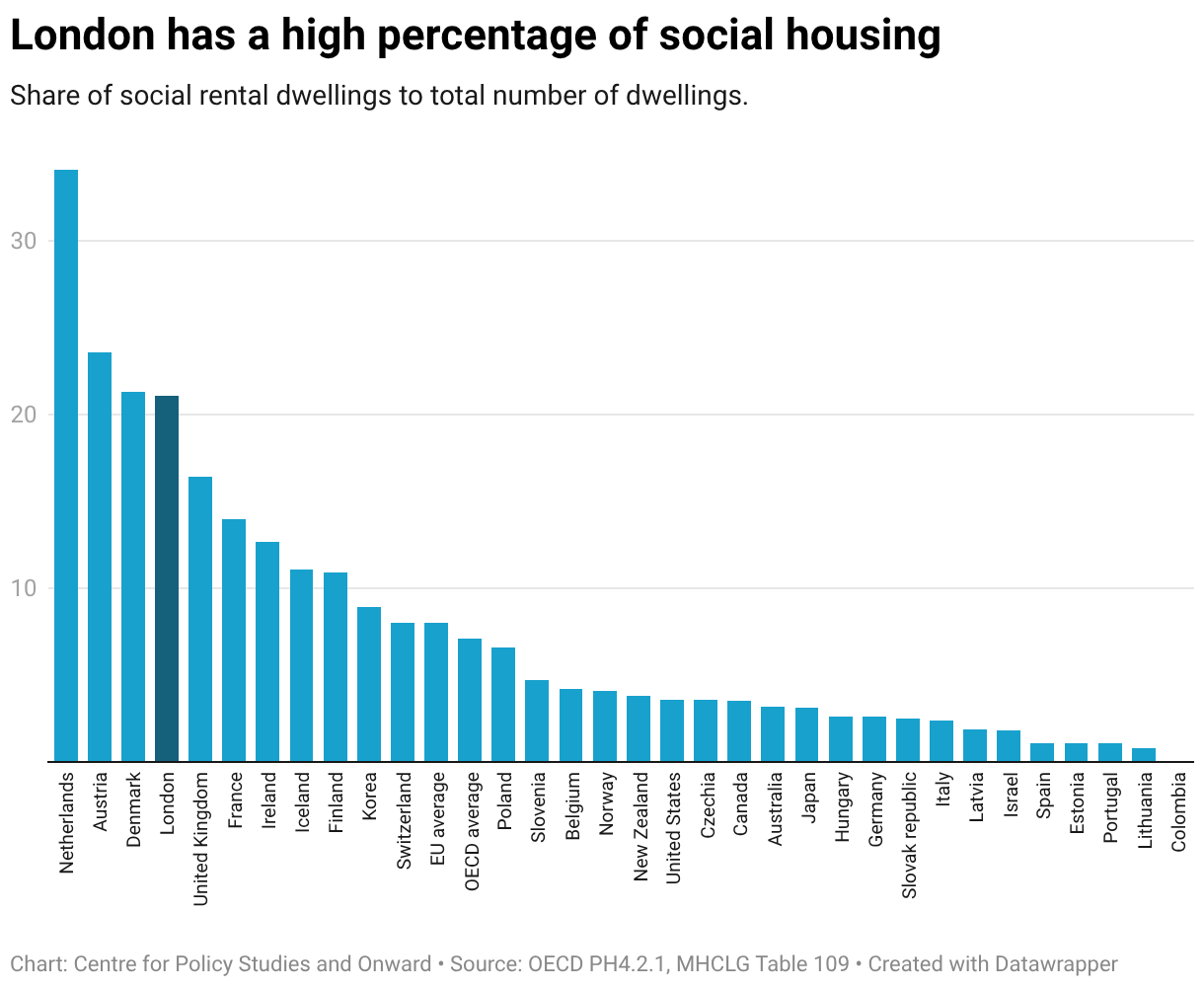
https://ukonward.com/reports/fixing-london-housing/
Onward, Onward is a UK centre-right think tank developing bold and practical ideas to boost economic opportunity, build national resilience, and strengthen communities. 1200627
Onward, Onward is a UK centre-right think tank developing bold and practical ideas to boost economic opportunity, build national resilience, and strengthen communities.310310
A foreword by the Rt Hon. Sir James Cleverly TD VR MP, Shadow Secretary of State for Housing, Communities, and Local Government
London succeeded because it combined ambition with opportunity. It is one of the world’s great cities because generations before us had the confidence to invest in its future, build for growth and create the conditions for people to succeed.
Today, that promise is under increasing strain. For too many Londoners, particularly younger people and families, finding a secure and affordable home feels further out of reach than ever before. That matters both for those individuals and for the long-term success of our capital and the prosperity of the country as a whole. A city that attracts talent from around the world must also remain a place where people can build a life, put down roots and look to the future with confidence.
This report brings renewed focus to the scale of London’s housing crisis and the consequences of failing to address it. It sets out a compelling case for how we can make better use of land, support regeneration, unlock brownfield sites and reduce the layers of red tape, regulation and complexity that have made it much harder to deliver the homes our city needs. Above all, it is a reminder that the decisions we make today will shape the opportunities available to future generations.
Successful development is about more than numbers alone. It is about creating places where people want to live, work and raise families. It is about supporting aspiration, widening opportunity and ensuring that economic growth is matched by improvements in people’s everyday lives.
Ben Hopkinson and Laurence Fredricks deserve credit for setting out a bold and ambitious vision for London’s future. At a time when the capital faces significant challenges, this report provides a detailed and thoughtful analysis of how we can build a more prosperous, dynamic and opportunity-rich city for the generations to come.
The Rt Hon. Sir James Cleverly TD VR MP, Shadow Secretary of State for Housing, Communities and Local Government.
A foreword by Laila Cunningham, Reform UK’s mayoral candidate for London
Let me start by telling you the truth.
I should not be writing this foreword. You should not be reading this paper. In fact, this paper should not even exist.
A city as wealthy, dynamic and successful as London should never have had a housing crisis. Yet after decades of failure by both Labour and Conservative governments and mayors, that is exactly where we find ourselves today.
London’s population has grown dramatically, driven in large part by mass immigration, while housebuilding has failed to keep pace. The result was predictable. House prices soared, rents exploded, and an entire generation of Londoners found themselves locked out of home ownership.
Instead of addressing the issue, City Hall has made the problem worse. Housing projects are burdened with endless bureaucracy, planning delays and ideological obstacles. Housing development should be one of the most attractive investments in London. Instead, too many investors look elsewhere.
This cannot continue.
As Mayor, I will fight to Make London Affordable Again. That means increasing housing supply, reducing unnecessary red tape, encouraging investment, and ensuring that London’s housing policies put the interests of Londoners first. Social housing is a limited public resource and must serve British citizens and those who have contributed to our society.
The housing crisis was created by political decisions. It can be solved by political decisions.
I would like to thank Ben and Laurence for their work. Their analysis of London’s housing crisis provides an important contribution to the debate and will serve as valuable input as we develop the policies needed to restore affordability, opportunity and home ownership to our capital.
Laila Cunningham, Reform UK London Mayoral Candidate
A foreword by Laurence Fredricks, co-author of Fixing London Housing
When I first moved to London as a recent graduate, I had no idea that I would become homeless. But last autumn, I became a sofa-surfer – one of the approximately 167,000 homeless people in the capital.
This was not a consequence of losing my job, or any financial problems. There were just not enough houses. Despite months of desperately searching for a new place to rent, I could not find any decent options. Even when properties became available, far too few were being rented at a price I could afford, even on a good wage.
When I did eventually find a place to live, it was not the end of my problems. Like many other Londoners, my rent today is roughly half of my post-tax salary, even before transport and bills. The very idea that I could ever save up to buy a home is frankly preposterous. And I am not alone. Young people of our generation who have done everything right, from getting a degree to moving to London and getting a well-paying job, are unable to build a life. The other day, one of my friends casually mentioned that he had moved 14 times in five years. Like many of our generation, he is now considering leaving the UK.
There is one obvious cause of this: there is far too little housing being built. In 2024/25, only 4,170 homes started construction in London. During that same period, the capital’s population grew by just under 100,000.
The solution is not complicated: we need more homes to be built. The current Government and Mayor were asleep at the wheel as building fell to its lowest level since World War 2 and only recently enacted temporary, ‘emergency’ reforms. Temporary reforms will not solve a long-running crisis.
For too long, it has been made harder and harder to build in the capital. A toxic combination of regulations, delays and political hesitation have constrained supply while demand has continued to grow.
There have been attempts to grapple with this reality. The last government recognised the scale of the challenge to build in London and began the work on reform. The then-Secretary of State, Michael Gove, commissioned a review into the London Plan. But this was cancelled by Labour’s Angela Rayner. Progress has since stalled, and the fundamental issues remain unresolved.
The outcome is that London cannot build, but it also cannot afford further delay.
And the opportunity is clear. As we set out in this report, London has the capacity to densify while remaining one of the most beautiful cities in the world. Matching the density of cities such as Paris or Osaka across Zones 1-3 could deliver hundreds of thousands of additional homes. And aside from giving people a place to live, it would generate significant economic reward, contributing billions to the economy.
Reversing London’s housing decline is a political, economic and generational imperative. This report sets out how the next mayor and government can, should and must do so.
Laurence Fredricks, report co-author
Executive Summary
London is failing to build the homes it needs. In 2024/25, construction started on just 4,170 homes in the capital, even as the population grew by close to 100,000. This dramatic fall in starts means that London is facing its largest housebuilding challenge since the Second World War.
This has been caused not just by global economic forces, but by policy choices that have increased construction costs, restricted the land that can be built on, and added more regulatory hurdles to clear.
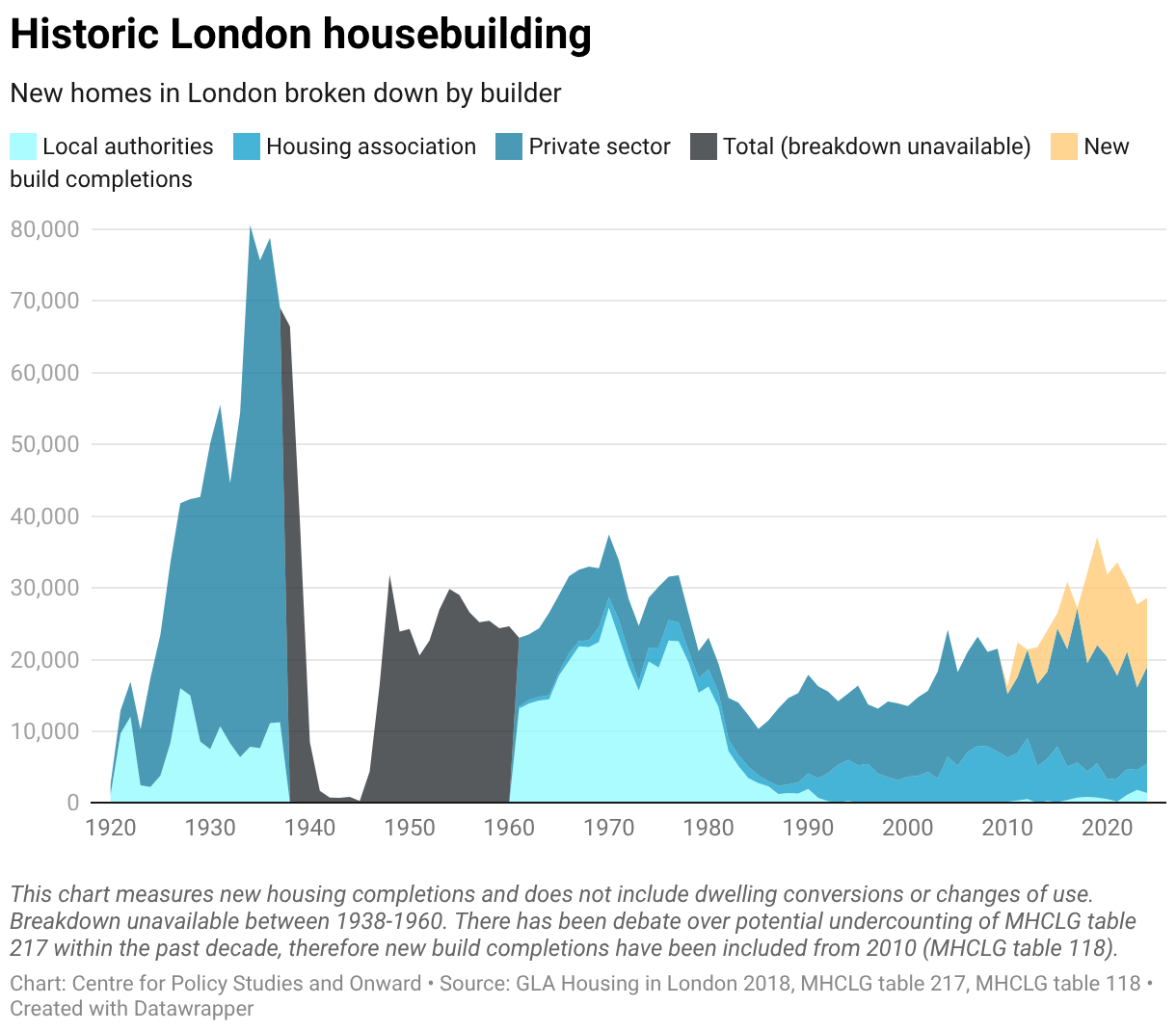
London has not built anywhere near the Government’s target of 88,000 new homes a year since the 1930s. Resolving London’s shortage by bringing the cost of housing closer to the cost of construction will require around 1.85 million additional homes, or roughly 100,000 a year over two decades.
This is achievable: cities like Tokyo and Austin already match or exceed that on a per-capita basis. But the consequences of failure are severe.
By the ONS’s definition of affordability, a household on the median London income cannot afford any property in the capital. House prices in London have risen 7.5 times faster than inflation since 1970. London’s failure to build is also raising house prices across the South East. This failure has national impacts: Public First estimates that meeting the 88,000 target would generate £14.8bn in annual GVA and over £6bn a year in additional tax receipts by 2034, enough to fund significant tax cuts.
For the Conservatives and Reform, the political logic points the same way. London is the region with the strongest local support for new building (59% in favour, 14% opposed) and inner London has relatively low centre-right support. The political cost of unlocking supply is therefore lowest precisely where the need is greatest. There is, in short, an unanswerable case for both parties to make a major London housebuilding programme central to their next manifestos.
This report sets out the case for such a programme, and a detailed prescription of how it could be delivered, along with clearly delineating which existing powers can be used and where they sit.
Chapter 1, on why London needs to build, establishes the scale of the shortage, its economic and social costs, and the case for treating London as the centre-right’s housing priority.
Chapter 2 identifies five categories of site capable of delivering the homes London needs:
Three mayoral or urban development corporations, covering the most strategic areas. These are Southern Tower Hamlets between the City and Canary Wharf (potentially 300,000+ homes), the Bakerloo Line Extension corridor along the Old Kent Road (at least 40,000 homes), and the existing Old Oak and Park Royal development corporation with an expanded remit (130,000 homes). Shadow corporations should be stood up before the next election so delivery can begin from day one.
Estate regeneration could deliver around 500,000 additional homes by roughly doubling the density of London’s low-rise post-war council estates, supported by an automatic-permission fast track for ballot-approved schemes, encouraging for-profit housing associations to build, and re-routing funding from the Social and Affordable Housing Programme.
Strategic Industrial Land and Locally Significant Industrial Site designations within a kilometre of a Tube, rail or tram station should be removed, unlocking 2,293 hectares of well-connected land sufficient for around 250,000 homes.
Use of public land should be optimised through five-year asset management pipelines, equal affordability treatment with private land, and Crown Development Orders for larger sites.
Brownfield land should benefit from a strong presumption in favour of development within the London Plan, extension of full expensing to remediation and regeneration, an exemption from Biodiversity Net Gain, and higher EIA screening thresholds.
Chapter 3, on making the most of existing properties, explains how to sensitively densify and improve the housing London already has:
To give homeowners greater choice over their properties, permitted development rights should be expanded to allow for full-size loft and rear extensions. Local authorities should create design guides for acceptable extensions within conservation areas. The Housing Secretary should also issue a statutory National Development Management Policy to create a national ‘yes unless’ route for household extensions that require a planning application, and should pass the necessary secondary legislation to implement ‘street votes’.
The conversion of existing commercial properties into homes should be made easier through the removal of regulations that prevent conversions, stricter limits on councils creating Article 4 directions that stop easy conversions, and the introduction of a statutory National Development Management Policy that explicitly encourages conversions and bans councils from introducing onerous barriers.
Around £18bn a year is spent subsidising people to live in London via the benefits system. This distorts the housing market and favours people who are out of work over working Londoners – at the taxpayer’s expense. We need to end absurdities like million-pound council homes and encourage more win-win transactions. The Housing Secretary should use existing powers to encourage councils to sell off expensive social housing when it becomes vacant, with the proceeds used to fund the construction of more homes. There should be a national cap on housing benefit and the Universal Credit housing component set at the median national rent for each house size for future claims. Finally, we should revive and improve the Right to Buy and expand it by including housing association properties.
Finally, Chapter 4 covers the policy and regulations choices that have constrained delivery:
Housing targets should be set according to the gap between median house prices and basic construction costs, which would raise London’s target to around 145,000 homes a year while reducing pressure on regions where demand is weaker. The Housing Secretary should also use their powers to designate underperforming councils, rewrite their local plans of underperforming councils, and call in larger applications in such areas.
Affordability requirements should be removed from the London Plan and replaced with a simpler unified Infrastructure Levy based on a share of development value.
A series of specific rules within the London Plan – covering private outdoor space, minimum space standards, dwelling mix, affordable workplace and student accommodation, car parking, emission standards and accessibility – should be unwound.
Nationally, second staircase requirements should be raised to 50 metres in line with France, Germany and Ireland, and Parts F, L, O and S of the Building Regulations loosened to pre-2021 baselines.
The Building Safety Regulator, which has been one of the most significant causes of London’s housebuilding slowdown, requires structural reform – either through an alternative, insurance-based route through the system or by raising the height threshold to bring the regime into line with international practice.
London’s housing crisis is solvable. In most cases, the policy levers exist within current legislation – and the political conditions are more favourable than at any point in recent memory. What is required is a programme of action ready to begin on the first day of a centre-right mayoralty or national government taking office.
1) Why London Needs to Build
London housebuilding is facing its largest challenge since the Second World War. Despite the capital having clearly the highest demand for new homes in any region in England, it is now building the fewest homes per capita. The rest of England is building at four times the rate.[1]
The Government has set London a housebuilding target of 88,000 homes a year.[2] But last year, it managed to start less than 5,000.
This is not just a short-term problem – although the current situation is certainly catastrophic. London has not been close to delivering the necessary level of new homes since the 1930s. But it has worsened recently, with surging demand as London’s economic prospects improved from the 1980s onwards stymied by a lack of new supply.
The failure to build more houses in London is more than just a wobble, or the temporary consequence of the botched introduction of the Building Safety Regulator. It precedes the consequences of high interest rates and surging build costs in the wake of the pandemic. It is the product of a steady squeeze, over years, on the number of places that can be built on and the profits that can be made by doing so.
If you restrict land use, add regulation after regulation, and attempt to squeeze out every pound you can from a development – or force developers to build a large proportion of unprofitable housing as part of the development – it is no surprise that you do not get any housebuilding.
The Government, and the Mayor of London have recently agreed an emergency plan to boost housebuilding. These measures include temporary relief from the Community Infrastructure Levy (CIL) where schemes meet affordable housing requirements; a time-limited planning route for developments meeting affordable housing requirements; and the removal of guidance in the London Plan that can constrain density – including limits on the number of flats that can be built around a building core. Affordable housing requirements were also temporarily downgraded from 35% to 20% of the project’s total in recognition of viability constraints.[3]
These are welcome steps, but they do not go far enough to get London building the homes it needs. Moreover, if these are measures meant to get more houses built, why are they temporary rather than permanent?
These emergency measures amount to fiddling around the edges, rather than making significant progress on resolving the large shortage. Based on the existing population of London, the capital needs 1.1 million more homes to get to the Western European average of homes per capita.[4] Yet even that understates the shortage. If we build more in London, workers from across the country will want to move to make the most of the higher-paying jobs. Getting the cost of housing close to the cost of construction should be the ultimate goal, as that is when the shortage would be resolved.
Ending London’s housing shortage therefore would require roughly 1.85 million new homes.[5] Clearly this is a large number and will not be built within a single mayoral or parliamentary term. Instead, the goal should be to build around 100,000 homes a year over the course of two decades. Globally, this level of building already happens in other major cities. The core metropolitan region of Tokyo averaged 155,000 new homes a year over two decades, the equivalent (adjusted for population) of London building at 104,000 homes a year.[6] Austin, Texas has recently liberalised its planning system and is now building 32,000 homes a year, the per capita equivalent of London building 113,000 a year.[7] As a result of building, both Tokyo and Austin have seen rents become more affordable.
The consequences of London’s housing shortage are brutal. The average house in London cost £5,298 in 1970.[8] Today it costs £554,000. Had house prices risen solely with inflation, the average London home would cost just £73,590. Instead, London’s house prices have outpaced inflation by over 7.5 times.
Had other goods increased in price as much as housing in the capital, a pint of beer would cost £17. A litre of petrol would cost £8, which means filling up an average tank would cost £400. A pint of milk would be over £5 and a dozen eggs would cost £24.
House price growth has also vastly outstripped wage growth. The average weekly wage for a full-time worker in 1972 was £32.[9] Had wages matched London house prices, the average worker would be on nearly £175,000, instead of £39,000.[10]
This is a catastrophe not just for the capital, but for the country as a whole. Yet it is felt most keenly by those young people who are trying to carve out a future for themselves.[11]
Housing affordability in London has collapsed Only the richest can afford even the cheapest houses.
The Office for National Statistics (ONS) classes any house as unaffordable if it costs more than five times a household’s income. As the chart above shows, this means that only the very cheapest houses are affordable – and then only to the very richest households. The average house is not affordable for anyone, even the top 10% of earners. By the ONS’s definition, a London household with a median income cannot afford any property, not even the cheapest 10%. As a result, the only people getting on the housing ladder are those with inherited wealth.
London’s high house prices are a disaster for aspiration and family formation. Given the cost of buying a home – especially a home suitable for families – it is of little surprise that London has the lowest fertility rate of the English regions.[13] Indeed, in 2022, the number of babies born in London was 20% down on a decade before.
London’s housing shortage has a knock-on effect on the economy
London is the UK’s economic engine, generating 22.3% of the country’s total economic output.[14] On an output per hour basis, the average Londoner is significantly more productive than someone living in the rest of the UK: GDP per person in London is £69,077 compared with £39,043 across the country.[15]
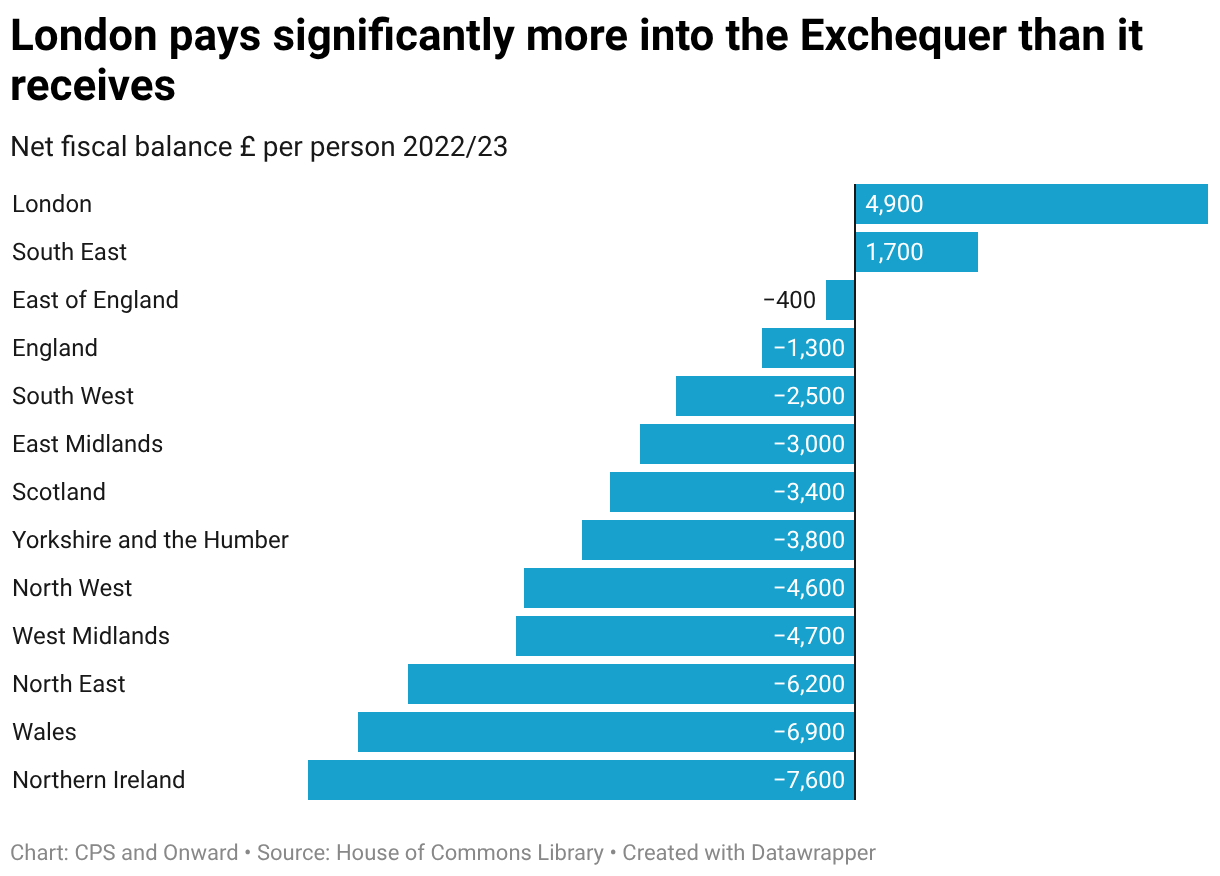
London’s economic success benefits the rest of the UK. In 2022/23, London generated £216.4bn in tax receipts, but government spending in the capital was only £172.8bn. That is a surplus of £43.6bn, or nearly £5,000 per Londoner, to provide public services to the rest of the country.[16] This means that the entire country does well when London is allowed to grow.
However, this growth is being artificially constrained. The number of jobs in London has grown far more quickly than the number of homes. Today, there are 61% more jobs in London than there were in 1996, but only 27% more houses. If London’s housing stock could keep up, the economy would grow much faster.
To see how extensive this shortage is, consider the following. The median London worker earns 17% more than the median UK worker. With those higher wages, people ought to be clamouring to move to the capital. However, once the rent of a one-bed flat is taken into account, the median London worker is actually 3% worse off than the median UK worker.[17]
To put that another way, many people could earn significantly more in London but are better off staying in a worse-paying and less productive job because of unaffordable housing.
And of course, what you get for that rental money is worse value than the rest of the country. For the average cost of renting a one-bed flat in London, a couple could rent a three-bed house in any other UK region. The average home in London is 10m2 smaller than the English average, despite costing 91%, or £264,000, more.[18]
The scale of London’s contribution to the national economy means that increasing its economic capacity delivers significant national benefits. Analysis by Public First has estimated that achieving the Government’s target of 88,000 homes per year in the capital could generate £14.8bn in annual GVA, or £118.7bn by the end of the next Parliament, boosting London’s GDP by 2.4%.[19] That includes potential benefits to the Exchequer of more than £6bn annually by 2034, including £4.1bn generated through the effects of more workers being closer to greater job opportunities in the capital.[20]
By unshackling the housing market in London, the government can raise greater tax revenues and use that extra cash to pay for public services or reduce or even axe unpopular taxes.
For example, the fiscal benefits outlined above would be enough for the government to halve the rate of inheritance tax for £4bn and remove inheritance taxes on family farms too.[21] Alternatively, the proceeds from enabling more housebuilding in London could fund 1p off of National Insurance Contributions or restore the personal income tax allowance for everyone, which would remove the pernicious 62% marginal tax rates between £100k and £125k.[22]
Whatever the next Chancellor chooses, allowing more housebuilding in London will enable tax cuts or public service improvements.
The economic success of London is underpinned by the capital’s housing market and density
London’s economy is driven by agglomeration, where density facilitates interactions between people, spurring social and economic activity. London is by far the densest of the UK’s cities, with an urban core approximately twice as dense as the average British city.[23] And this concentration delivers major economic returns: roughly 13% of the UK’s population is in London, but the city contributes 22.3% of the UK’s GDP.
Yet compared to many of its rivals, London is not actually that dense at all. Relative to Paris, London’s urban core is missing around 700,000 homes and almost 950,000 compared to Osaka in Japan.[24] Just matching Parisian density in Zones 1-3 would add 500,000 more homes.[25]
The underutilisation of land is visible across the capital. Take Tower Hamlets, the UK’s densest and one of the most economically productive boroughs.[26] Despite having the highest GVA per hour worked in the country and supporting more than 160,000 jobs, densities within the borough vary dramatically: you can go from the skyscrapers of Canary Wharf to terraced housing in under 500m.[27][28]
In short, fixing London’s housing crisis is an economic necessity for Britain. But it is also a political necessity for the centre-right.
London’s housing failure has spread the housing crisis across the South-East
People would like to live in London for all sorts of reasons. But many of them cannot afford it and are forced further out. That means house prices rise in the towns and cities that surround London, like Guildford, Brighton, and Reading. That in turn pushes people further out and prices up in surrounding towns and villages and puts added pressure on the green belt.[29]
The construction of new houses has historically been a complicated political area for the centre-right. While home ownership is foundational to building communities and giving the young a stake in society, new construction is less popular among right-leaning voters than left-leaning voters. Recent Ipsos polling shows that while 63% of 2024 Labour voters support building more in their local area, only 39% of Conservative and 27% of Reform feel the same.[30] That’s compared to 33% of Conservative voters and 46% of Reform voters who oppose building more homes near them.
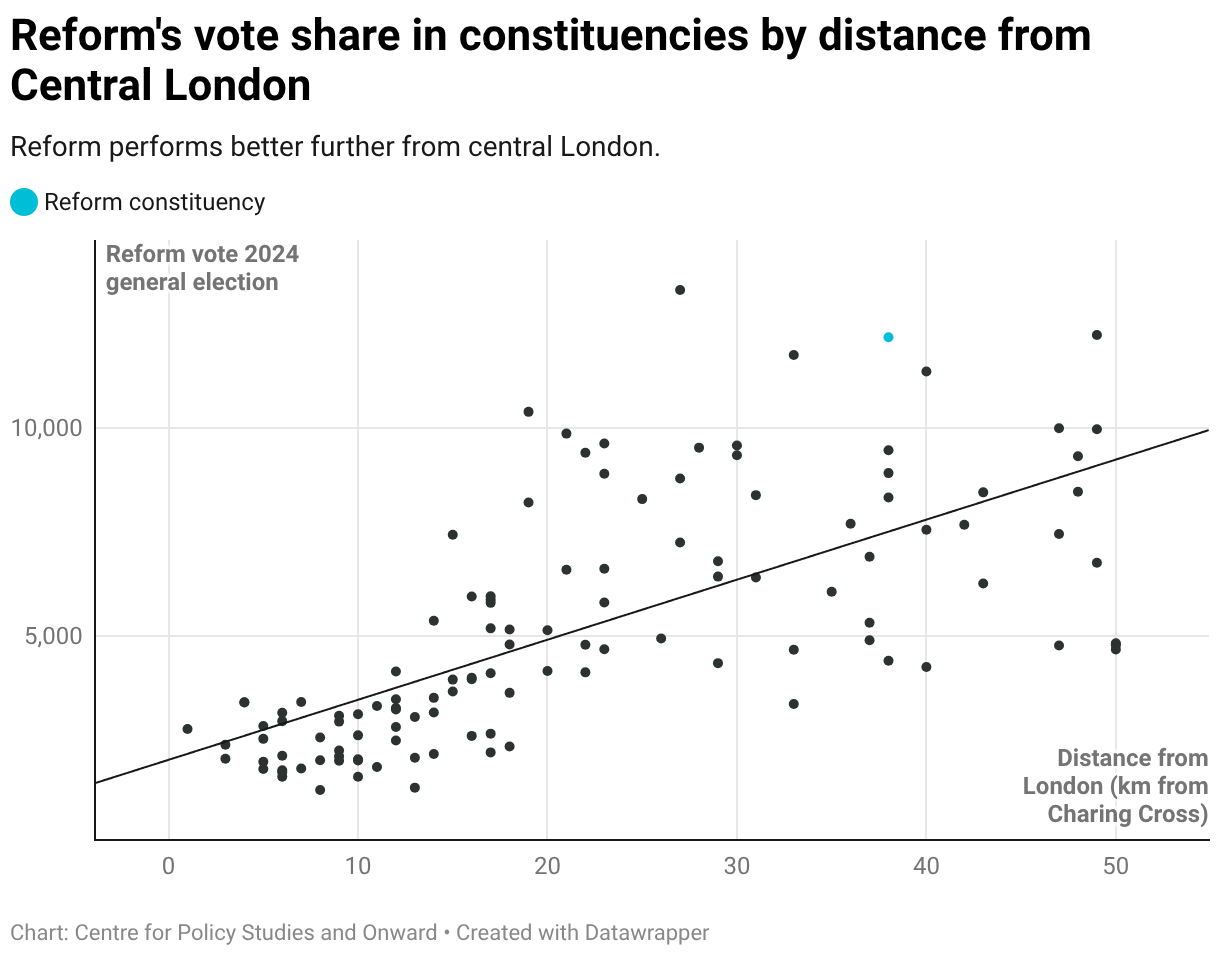
London, especially central London, is both the UK region with the highest support for new construction in the local area (59% in favour versus 14% against) and also a region with relatively low centre-right support. At the 2024 election, Reform did not win a single constituency in London. The Conservatives did not win a constituency that did not border the Home Counties. Chingford and Woodford Green was the closest to central London, and that’s nearly ten miles from Charing Cross.
In short, building more homes in London is popular with existing residents, less likely to anger existing centre-right voters – and dilutes pressures in the rural and suburban seats that centre-right parties traditionally hold.
The two following charts, from the 2024 election, show that the further a constituency is from central London, the more votes both Reform and the Conservatives tend to win.
To put specific numbers on that: within Greater London, there were 46 constituencies where the Conservatives received fewer than 10,000 votes in 2024, compared to 29 where they received more than 10,000. For Reform the numbers were even starker. There were only two constituencies where they won more than 10,000 votes (Hornchurch and Upminster and Old Bexley and Sidcup), and 73 where they received fewer than 10,000 votes.
This trend mostly continued with the 2026 local elections. The Conservatives and Reform achieved their best results in outer London boroughs while the Greens and Labour were more successful in inner London, except Westminster and Kensington and Chelsea.
Past attempts to reform the planning system and boost housebuilding levels have failed, in large part, due to political backlashes. Given the necessity of addressing the housing shortage, it is vital that any future government on the right prioritises unlocking development in areas where local opposition is weak and where the political cost of local opposition is the lowest. All of those factors point to London, where the housing shortage is most dire, local residents are most supportive of new building, and the centre-right faces the lightest political headwinds for more building. Building in London also reduces the pressure to build in the green belt, which is unpopular with centre-right voters.[31]
In short, there is a pretty unanswerable case that both the Tories and Reform should prioritise a major housebuilding programme in London. But how many homes, and where?
2) Where to build
Perhaps the first question that comes to mind when thinking about increasing housebuilding in London is, where? That’s especially pertinent given the approximately 1.85 million homes London needs. Isn’t the capital full, with no land to build on?
There is, of course, some truth to this; London is by far the most built-up region in the UK.[32]
But London is also full of opportunities to make better use of existing land. Existing land use policies have artificially restricted where new homes can be built. Social housing built in the 1950s through 1970s is both low density and in need of major regenerative work. For more strategic sites, co-ordination challenges and councils with limited incentives to drive forward change have stopped neighbourhood-scale new developments. Public land and other brownfield sites also provide significant opportunities but have been underdelivering.
We propose five different types of locations where London can and must build the homes it needs:
Mayoral or Urban Development Corporations should be established for the most important strategic sites.
The first of these should cover the area between the City of London and Canary Wharf, which has the potential to be a global economic powerhouse with millions of square feet of office space and at least 300,000 new homes.
The second would improve the effectiveness of the existing Old Oak and Park Royal Development Corporation, which is hobbled by restrictions around land use imposed by the current Mayor. This area is surrounded by Tube and rail stations, including the future HS2 megahub, and has the potential for 130,000 new homes in addition to retail and office spaces.
Finally, a third corporation should cover the area along the Old Kent Road served by the planned Bakerloo line extension, which has the potential for at least 40,000 homes.
We should focus on renovating existing council estates that are built at low densities. By expanding the successful policy of estate regeneration with new planning and financing powers, the uplift in density at existing estates could deliver 500,000 additional new homes.
We should remove Strategic Industrial Location status from areas within a kilometre of an existing Tube, rail or tram station. This could provide the space for 250,000 well-connected homes.
Public land should be optimised for housing by requiring public bodies to identify developable sites and create clear five-year delivery plans, with Crown Development Orders used for larger sites.
A clear, strong presumption in favour of brownfield development should be introduced within the London Plan to resolve policy conflicts, combined with full expensing for brownfield land regeneration projects, and exemptions from biodiversity net gain. Brownfield reform is the foundation that makes the strategic sites set out above deliverable, and would additionally unlock substantial dispersed capacity on smaller brownfield sites across London.
Of course, identifying the land on which to build is only the first step and will not solve London’s housing shortage alone. In future chapters, we will discuss making the most of existing properties alongside new developments, high affordability requirements that destroy viability, the regulations and policies that need to be changed, and incentivising local councils to allow more construction.
But for now, we will focus on the parts of the city where the opportunities for densification and regeneration are greatest.
Special/Mayoral Development Orders and Development Corporations
Many of the recommendations in this report are about making the housing market work better. But to make the most of the biggest opportunities in London, government involvement is needed – if only to clear away the obstacles that are blocking development.
Development corporations have already proven themselves in the capital with the transformation of dilapidated docklands into Canary Wharf, one of the world’s great financial centres. Likewise, the Olympic Games led to the transformation of areas near Stratford from rundown industrial land into thriving new neighbourhoods.
Development corporations can be the organising force behind major regeneration projects. They can act as the local planning authority, which means creating both a local plan and approving planning applications, but they do not face the same financial pressures that local authorities are currently experiencing. They also have the power to resolve potentially thorny problems around land assembly, infrastructure provision, and development phasing.
Both the Secretary of State and the Mayor of London have the power to create development corporations. The London Docklands Development Corporation that drove the creation of Canary Wharf and the revitalisation of much of the East End was created by the Thatcher government. The London Legacy Development Corporation that cemented the success of the Olympic Games in regenerating Stratford was created by Boris Johnson when he was Mayor of London.
There are areas of central London where we can recreate this success. The three best options are the area between the City and Canary Wharf, the Old Oak Common and Park Royal industrial area, and along the Old Kent Road where the Bakerloo line extension is planned to run.
Old Oak Common and Park Royal already has a development corporation, but this is severely restricted by the land use policies that Sadiq Khan has applied. These policies and the resultant local plan can be changed by a future Mayor or Housing Secretary.
While development corporations are already powerful organisations, there is potential to further increase their powers to deliver at the scale needed. Any compulsory purchases at the beginning of construction will need to be funded from capital markets. This can all be self-funding given the large increase in land values if the development corporations are given the ability to borrow and are exempt from the fiscal rules.[33]
One of the most important challenges with this solution is the time it takes to deliver. All three of our suggested projects are major undertakings that will outlast a single mayoral or parliamentary term. To have the best chance of success, work must begin immediately after an election. In the run-up to an election, whether it be mayoral or general, parties on the centre-right should establish a shadow development corporation for each of these areas. The shadow development corporation could outline the goals of the regeneration and begin creating the plans for redevelopment so that on the first day of the next Mayor or Parliament’s term, the development corporation could be created quickly.
To further speed up the planning process, a special development order or a mayoral development order could be applied to the plans that the development corporation draws up. This would quickly grant planning permission for developments that match the plan. Such a combination was used successfully in the 1980s to deliver a large-scale regeneration project around Cardiff Bay.
Southern Tower Hamlets
London contains two of the centres of global finance, the City and Canary Wharf. The Square Mile alone has a GDP over £110bn, which rivals entire countries like Kenya or Croatia.[34] These are two of the most economically productive areas anywhere in the world. This level of economic activity is visible from London’s skyline too: one cluster of skyscrapers in the City and another in Canary Wharf. Yet there is a three-mile gulf between them.
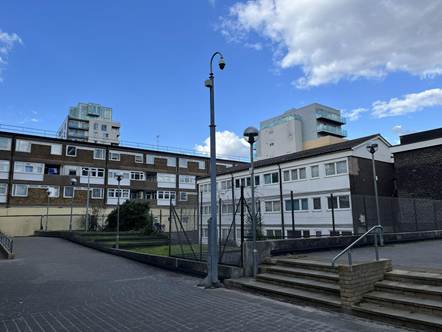
In Tower Hamlets the skyscrapers of Canary Wharf are 300m away from two-storey terraced houses. More than 50% of the homes in this output area are socially rented
The drop-off is sudden. Some of the tallest buildings in the country are less than 300m away from two-storey terraced council homes. Instead of being full of mixed-use residential and office buildings, the area is mostly low- or mid-rise council housing. In some neighbourhoods, 55% of homes are socially rented.[35] The existing housing stock is mostly from the 1950s and 60s and is increasingly in poor condition. This land has the potential to cement London’s status as one of the most important cities for the global economy, yet it is currently being let out at far below what it is worth.
An ambitious government has the potential to change this.
The areas of Poplar, Shadwell, and Limehouse should all fall under a new development corporation with the explicit mandate of maximising the economic productivity of this high-potential area. Mixed-use developments of new homes, offices, lab spaces and commercial buildings should be targeted. This area is prime for a new generation of high-rise buildings, which will complete London’s skyline and become not just an economic hub for London, but potentially for the country and world.
These Tower Hamlets sites are both within easy walking distance of the most economically productive area in the country
Given that existing land ownership is fragmented, which would make coherent redevelopment challenging, the next Government should introduce the primary legislation enabling land readjustment. This mechanism, used successfully in Japan, Spain and other countries, allows various owners of a fragmented area of land to pool that land so that it can be developed as one.[36] The original owners are then compensated with a new parcel of land that has significantly appreciated in value given the redevelopment. The development corporation could function as the adjudicating body of the necessary land readjustment.
Existing residents should be given a right to return to newer, nicer properties or an option to cash out. This can be funded by the significant uplift in land values that the development corporation will create.
For such a large-scale redevelopment, new transport links will need to be developed. Already the Elizabeth line and DLR provide good connectivity, but more can be done. A forthcoming report by a group of transport policy thinkers and planners will lay out the possibilities around Crossrailing the line into Fenchurch St, which would provide rapid connections from Southern Tower Hamlets across central London.[37] The report will detail the feasibility of self-funding this project solely through land value capture. This project would also allow the conversion of the existing railway arches corridor from Fenchurch St to West Ham to a DLR service with higher frequencies than the current national rail service.
This is a large and complex undertaking and will take time. Yet it also has the potential to reshape London’s economic and cultural geography for centuries to come. Because of the time involved, the broad strategic goals of the development corporation should be set in opposition and the primary legislation for land readjustment drafted, so that the development corporation can be created on the first day of a new government.
Old Oak Common and Park Royal
The Old Oak Common and Park Royal area provides the best opportunity within London to create a new neighbourhood.
When Old Oak Common station opens, this area in West London will have a credible claim to being the best-connected place in the entire country. HS2 trains will speed towards the Midlands, the North West, and Scotland. The Great Western Main Line will provide easy access to the West Country, South Wales and Oxford. The Elizabeth line station will mean Heathrow is 20 minutes away and central London a mere 10. That’s in addition to the 11 existing Underground stations on the Piccadilly, Central, Bakerloo and Overground lines that surround the site. If the West London Orbital goes ahead, there will be a third Overground line to connect the area to more parts of West and North London.
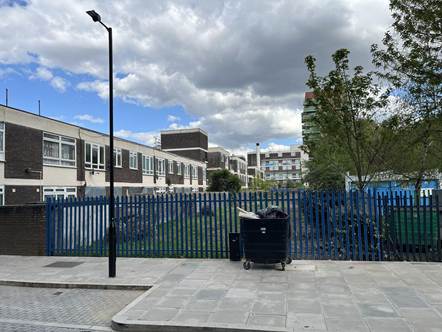
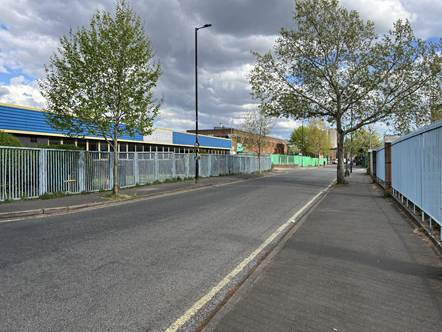
For such a well-connected location, the urban environment is distinctly underwhelming. The Park Royal area is made up of street after street of single storey warehouses. There are a surprisingly large number of Lebanese bakeries too, and a McVitie’s biscuit factory. The only reason that industry has continued to cluster here is that the land is legally protected by the London Plan from being redeveloped into a mixed-use neighbourhood. In effect, that results in large subsidies for the existing industrial uses.
A collection of scenes from Park Royal. This is all legally protected land that cannot be redeveloped into homes despite being surrounded by Tube, rail, Overground stations and soon HS2
Take Channel Gate, an industrial site between Willesden Junction and the future Old Oak Common station. Channel Gate is currently partially being used to construct the HS2 station, with the rest of the site being open storage land and a bus depot. In 2021, the nine-hectare site was valued at £92.8m given its existing uses.[38] But if it were regenerated into 3,100 homes, the land value could go as high as £312.5m. That means because of the strategic industrial location designation, there is an implicit subsidy of around £220m for just this one site, or around £25m per hectare.
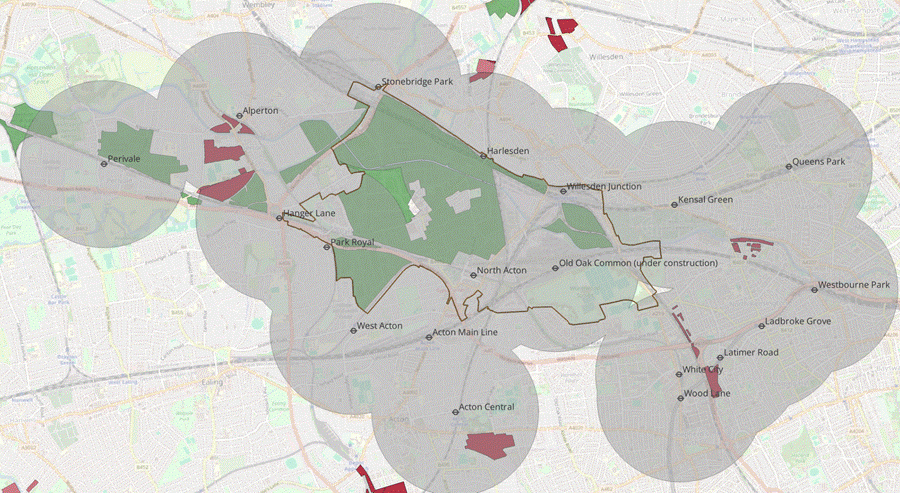
Within Park Royal there are 325 hectares of SIL that are within a kilometre of a station. By applying the Channel Gate rate of implicit subsidy, that’s £8bn of land value that could be unlocked if we liberalised planning in just this one small area of West London. At Parisian densities of 400 dwellings a hectare, this well-connected land provides enough space for 130,000 homes, plus at least 300,000 square metres of retail and office spaces.
Map showing the opportunity in Park Royal. The existing development corporation’s boundary is shown, alongside Strategic Industrial Locations (green), Locally Significant Industrial Sites (red), and a 1km radius around stations (12-minute walk).
Old Oak and Park Royal will also be the fastest area to deliver because it already has a development corporation set up. The existing development corporation is re-developing parts of the site, including a 28-hectare site near the HS2 station, however this is less than a tenth of the opportunity that this area brings.[39] The challenge is that the Old Oak Park Royal Development Corporation does not have the ability to overturn SIL designation and has been very conservative in suggesting removal of SIL status. The corporation’s Local Plan commits
specifically to no net loss of industrial floorspace within the local area.
That is simply too limiting to take advantage of potentially the best opportunity in a generation to build a completely new area of London. The existing industrial land is absolutely not the best use of this well-connected Zone 2 site.
The arguments for banning new homes on SIL do not add up. While it is true that the workplaces for tens of thousands of Londoners are in a SIL, it does not follow that their jobs would disappear if the site was redeveloped. Some industrial users may move out of London to cheaper parts of the UK that are better connected to the strategic road network, while others may find ways of co-locating. The Mayor and Housing Secretary should actively encourage new industrial sites to come forward in and around London that are well-connected to the road network. Additionally, there would be opportunities for new businesses, such as life science labs or start-up offices, to move into mixed-use communities.
The Government should plan for the reprovision of industrial land where possible, especially by allocating new industrial sites in and around London that are well-connected to the road network. But it should not arbitrarily insist that it has to remain in the same location so close to central London.
Another argument is that having warehouses in central London means that delivery drivers have to drive fewer miles, helping traffic congestion. This is true, but it misses a wider truth. The environmental benefit of the shorter drive is vastly outweighed by the opportunity of giving over a hundred thousand families the chance to own a new home. Additionally, redevelopment of the area will involve people moving from outer London, closer to the centre where there is less need for them to drive or own a car, reducing congestion on the roads.
The Mayor of London should expand the remit of the existing Old Oak and Park Royal Development Corporation to include the Strategic Industrial Locations and amend the London Plan to remove the Strategic Industrial Location designation.
Alternatively, the Housing Secretary could resolve the issue of the existing industrial land through a two-part process. First, the Housing Secretary would need to remove the Strategic Industrial Location designation from the London Plan, which could be done through sections 340 and 341 of the Greater London Authority Act 1999. That would direct the Mayor to make the necessary changes to the London Plan. Then,the Housing Secretary should use their powers under s15GA of the Planning and Compulsory Purchase Act 2004 to revise the local plan of the Old Oak and Park Royal Development Corporation so that it no longer treats the relevant land as SIL and instead allocates it for the intended regeneration-led use.
Either the Mayor or the Housing Secretary can resolve the issue of uneconomic warehouses subsidised to be in the best-connected area in the country. Having made the necessary changes to the local plan, the existing development corporation will then be able to build London’s newest neighbourhood surrounded by the existing and new HS2, National Rail, Elizabeth line, Underground, and Overground stations.
Old Kent Road and the Bakerloo Line Extension
Most Brits will know the Old Kent Road because it is the cheapest property on the Monopoly board. There are strong reasons for this. The current road is traffic-clogged and subject to a hodgepodge mix of new development, worn-out estates, big-box retail and dilapidated industrial sites. It is also the Monopoly board street furthest from a Tube stop.
The Bakerloo line extension (BLE) will change this. Proposals to extend the Bakerloo line from its Zone 1 terminus have been mooted since before the line even opened in 1906. The current plans for an extension along the Old Kent Road trace their origin back to 2006. Yet despite over a century of talk, we are no closer to delivery. Opening the BLE is an opportunity to connect the largest public transport desert in central London and build tens of thousands of homes at the same time.
The planned route of the Bakerloo line extension including new stations at Burgess Park and Old Kent Road and connections to the existing national rail stations at New Cross Gate and Lewisham (Source: Wikimedia)
Tying a transport project to a regeneration scheme has worked well in London before. Before the Northern line extension, Battersea Power Station sat empty. Though physically close to London’s centre, poor transport links made redevelopment an unviable proposition. Two new stations and a link to one of London’s most used Tube line changed that, allowing for 20,000 new homes, a new UK headquarters for Apple, and a vibrant tourist attraction. The construction around the power station generated enough business-rate growth and developer contributions to repay the borrowing used to build the Underground extension.
The BLE exists in similar circumstances: close to central London but poorly connected and rundown. The Old Kent Road is dying and the new cannot be born (until the BLE is delivered); in this interregnum a great variety of morbid symptoms have appeared. The area is loud and congested, with a constant churn of buses and delivery vans. There’s a scattered mix of large retailers with massive car parks, warehouses and tired-looking parades of takeaways and betting shops. Patches of new development sit awkwardly beside neglected plots and ageing estates.
Scenes along the Old Kent Road. The first two surface car parks are the planned sites of future Bakerloo line stations
The Old Kent Road is also shockingly low-density, partially as a result of relying on buses rather than an Underground line. Despite being just 2.5 miles from the centre of London, the areas around the future stations average 46-57 homes per hectare, about the same as terraced housing.
Sadiq Khan has claimed that 20,000 homes could be built along the proposed Tube line. However, that is hugely unambitious. Getting the level of density around the stations up to 100 homes per hectare, about the same density as Greenwich, would unlock double the number of homes that the Mayor is planning. Even more homes could be unlocked with a local plan aimed at reaching Parisian densities of closer to 400 homes per hectare.
Within the area near the station there is significant opportunity for a development corporation to deliver these homes. There are 47 hectares of Strategic Industrial Land (SIL) and 17 hectares of Locally Significant Industrial Sites (LSIS) within walking distance of the proposed stations. If built at 400 dwellings per hectare, similar to Parisian densities, this land would host over 25,000 homes.
Likewise, there are 43 council estates within walking distance of the proposed stations. These were built at a time when London was depopulating and the primary concern was overcrowding. That means that despite some of these sites containing a tower block, they were actually built at relatively modest densities: 110 dwellings per hectare average in Southwark and 77 dwellings per hectare in Lewisham. Estate regeneration, discussed below, could net a further 15,500 additional homes by replacing the existing, outdated estates with higher-quality new homes.
A development corporation is the best vehicle for regenerating the area along the Old Kent Road. At the same time, the corporation could focus on raising money to deliver the extension through targeted land value capture. Currently, significant parts of land value capture go towards the provision of subsidised housing through affordability percentages and section 106 commitments. Instead, the corporation should be targeted specifically to maximise the amount of funding to help deliver the BLE. That means choosing contributions towards infrastructure over subsidised housing and encouraging developments that maximise land value. One of the reasons why the extension has yet to be delivered is squabbling over who is going to fund it. The development corporation model is the answer here.
Estate Regeneration
The Aberfeldy estate was built on bomb-damaged land near London’s docks. It used to be
poorly connected and economically isolated. However, with the arrival of the DLR and Jubilee line and the regeneration of the Docklands, the estate now has easy access to the City and the West End and is within walking distance of a global hub of finance at Canary Wharf. Yet the terraces and flats have fallen into disrepair and are built at a low density, meaning that this superb location could be redeveloped to benefit more working families.
A plan to regenerate the existing 330 council homes into 1,582 homes had overwhelming
support from residents. In a ballot, 93% voted in favour with a turnout of 91% because they
would receive newer, larger properties.[40] These replacement social homes for current tenants would be paid for by selling most of the other new homes. The only hitch to this plan was that despite complying with the local plan, Tower Hamlets’ Planning Committee unanimously voted to reject the scheme on spurious grounds, including that local people would be ‘pushed out’ and that the buildings would be too tall.
While this project was ultimately called in and approved by the Mayor, the planning difficulties added two and a half years to the project’s timeline.
Aberfeldy Village in Poplar, before and proposed (Sources: Sawyer Fielding and NLA)
Aberfeldy is just one example of a much larger problem. Most council estates in London are
built at low densities while taking up prime real estate. Britain Remade suggests that the average council estate in London has approximately 70 dwellings per hectare, about three times less dense than some of London’s most beloved neighbourhoods like Maida Vale or Marylebone.[41]
If existing London estates were roughly doubled in density to between 126 and 146 dwellings per hectare, more than 500,000 new homes could be delivered. So great is London’s housing shortage, and the lack of density of existing estates, that large-scale estate regenerations could produce an estimated surplus of more than £80bn.[42] This could be spent on infrastructure upgrades, rewarding residents, or cutting council tax.
Estate regenerations are a rare example of housing policy where everyone wins, including existing residents, neighbours, and new residents. When estate regenerations do happen, they’re immensely popular with existing residents. Since Sadiq Khan made ballots mandatory for estate regenerations, there have been 41 successful ballots, compared to just two unsuccessful ballots. One of those two projects was then updated according to residents’ preferences and subsequently won their support.
Existing residents are so supportive because they get to move from existing, run-down flats into newer flats in an improved local area. Existing estates are often now in unacceptably poor condition; more than half do not meet new minimum energy efficiency standards and 54% lack any insulation. Of the 10 worst UK local authorities for damp and mould complaints, eight are in London.[43]
Local people who live near the estate also benefit from renewal. The urban fabric in their area is improved by removing the eyesores of 1960s design and better integrating the estate into existing streets. Concerns over crime and antisocial behaviour is alleviated, as the renewed estate can be designed with CCTV, street lighting, and modern security systems. Plus, estates will no longer be concentrated pockets of destitution, but liveable, mixed-tenure communities.
Finally, more homes for private sale or rent means more people can live in the capital with easy access to well-paying jobs, boosting the economy.
To encourage more estate regeneration projects to happen quickly, the Government should introduce an estate regeneration fast track. If a majority of residents vote for a plan to densify their estate, they should get automatic planning permission, subject to confirmation from the Planning Inspectorate. This could use the primary legislation laid out in Section 106 of the Levelling Up and Regeneration Act 2023. In the interim, the Mayor of London or the Housing Secretary could commit to calling-in and approving every estate regeneration that passes a ballot.
Besides planning, one of the main reasons that estate regenerations do not go ahead is the financing challenge and lack of an incentive to deliver projects for cash-strapped local authorities or non-profit registered providers. That means councils tend to only have the capacity and resources to advance one or two projects at a time.
The solution to this financing challenge is boosting the ability of for-profit registered providers to deliver estate regeneration projects. Already, local authority estate residents have the power to request a transfer of their estate from the local council to a housing association. This power should be expanded through primary legislation to enable the transfer of an estate from a housing association to another housing association if the residents vote for it, subject to reasonable compensation to the original housing association.
To further ease the financing of estate regenerations, the Mayor should make estate regeneration projects the priority recipients of the £11.7bn Social and Affordable Housing Programme. Given that estate regeneration projects help to drastically improve the stock of existing social properties, the programme’s current focus on net additionality should be removed.
Alternatively, the Housing Secretary could add stipulations to future affordable housing programmes to encourage more money being spent on unlocking these projects. Delivering more homes is the most important way to drive affordability in the capital, which estate regenerations deliver while also greatly modernising the existing social rent stock in London.
Finally, the Social Housing Regulator should amend its Governance and Financial Viability Standard to allow for-profit registered providers to make more than 5% of their turnover from non-social housing activity. This would allow for-profit registered providers to generate revenue from selling a portion of the new homes built within an estate regeneration scheme. In turn the sale of these homes, if built in high enough density, can fund the wider project.
The Packington Estate, before and after regeneration
By getting the incentives right, we can encourage these registered providers to identify the estates that have the best opportunity to be renewed. In turn, they can make a compelling offer to existing residents, who will benefit from the value uplift that the regeneration provides. They also have a strong incentive to vote for more homes as the uplift funds larger homes for existing residents and nicer green spaces. If the plans pass a ballot, the sponsors should be allowed to get on with building.
Strategic Industrial Land
London’s industry flourished in the 18th century along its rivers and in the 19th century along its railways. Yet these historical patterns of industry have been frozen in place by our planning system. The River Wandle, which flows from Carshalton and Croydon to the Thames at Wandsworth, used to have 68 mills along its length, which manufactured textiles, paper and tobacco. The mills are long gone, but a large number of single-storey warehouses have taken their place.
Likewise, large industrial sites have grown up in West London, along the Grand Union Canal and sandwiched between the Great Western Main Line and the West Coast Main Line. East London has significant industrial land along the River Thames and North London has industrial land along the River Lee Navigation and West Anglia Main Line.
All of these sites are located where they are because of industrial geographies of the past, not the present day. Yet, the warehouses are legally protected against redevelopment by the London Plan’s Strategic Industrial Location (SIL) policy and by local councils designating Locally Significant Industrial Sites (LSIS). But the industry of today clearly does not need to be built around rivers, railways, or the tram stops that have been built near the Wandle. It needs to be near the strategic road network.
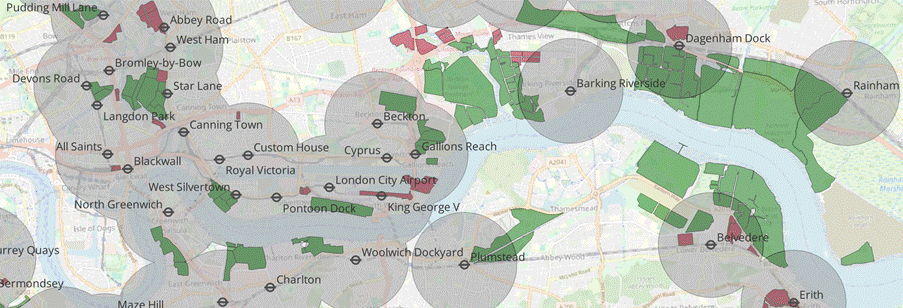
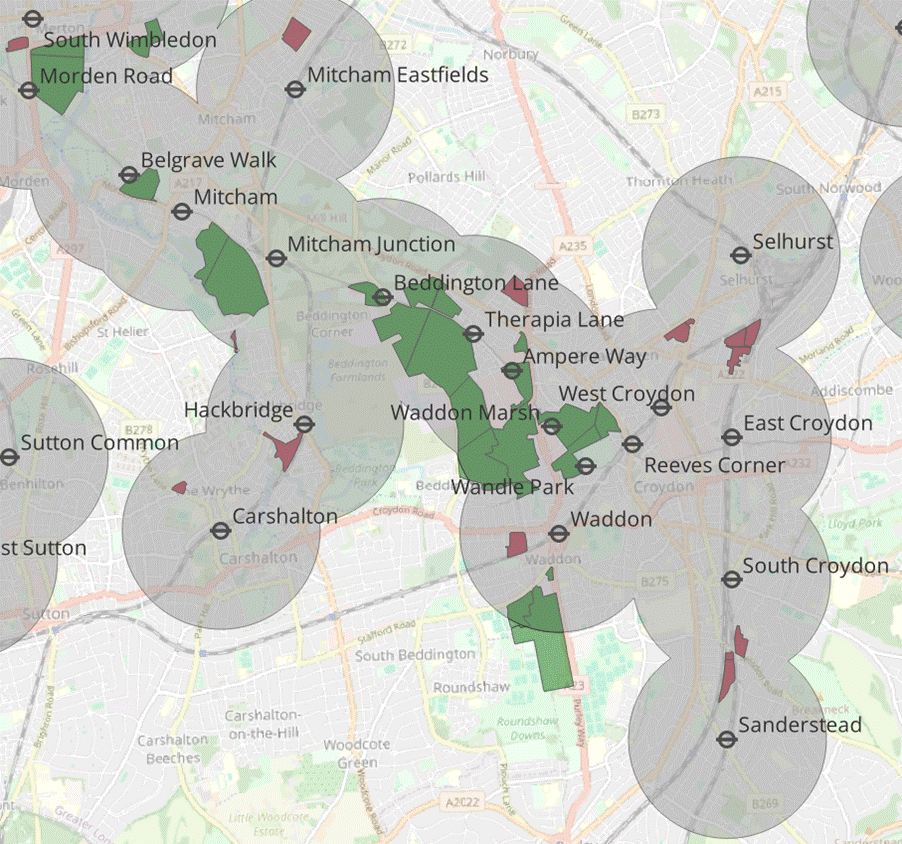
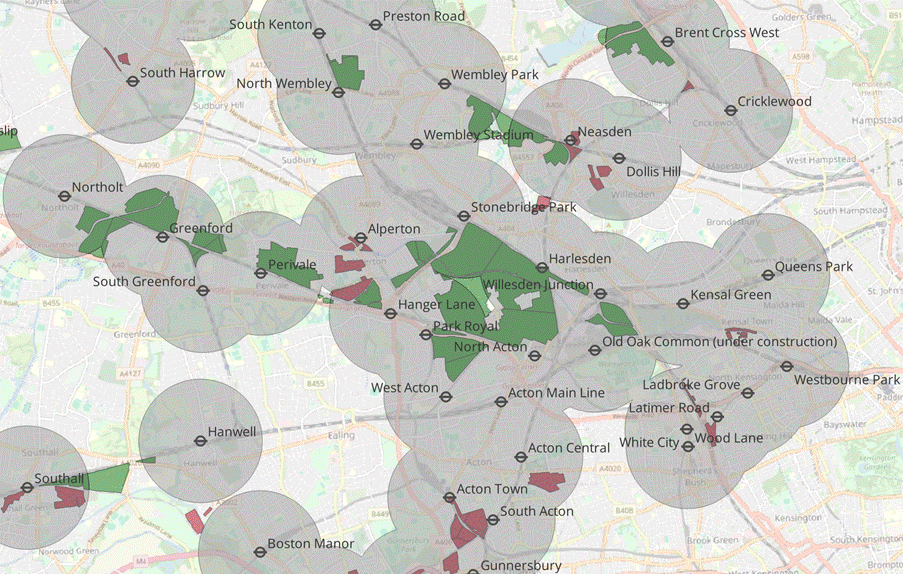
All stations in London that have either SIL (green) or LSIS (red) land within a kilometre (12-minute walk)
A designation as SIL or LSIS de facto bans the building of new homes. It also implicitly subsidises existing businesses at the cost of Londoners who struggle to find a place to live. Land in London with permission for homes is worth seven times more than the same hectare used for industrial uses.[44] By continuing to ban new homes on existing industrial land, we are taking away the pressure and ability to regenerate these areas into new mixed-use communities.
This point is worth stressing, because of the sheer amount of land that is protected by the Mayor’s SIL policy and local councils’ LSIS designations. In total, there are 3,519 hectares of SIL and 1,098 hectares of LSIS across Greater London.[45] That’s the same size as the boroughs of Kensington and Chelsea, Islington, and Tower Hamlets combined.
Left: This street is a three-minute walk from the Battersea Power Station Tube stop. The buildings on the left, not on SIL land, contain 853 student rooms and 44,000 sq ft of office space, while the building on the right is legally protected against redevelopment because of its SIL status. Right: The same buildings from a different angle
Partially as a result of industry historically concentrating near railways, a lot of this land is close to Tube, train and tram stops. Within a kilometre of existing stations, or about a 12-minute walk, there are 2,293 hectares of SIL and 800 hectares of LSIS, which is mostly made up of single-storey warehouses. Taken together, that’s an area 22 times the size of Hyde Park. If built at a gentle density, that land would be enough for 250,000 well-connected homes.[46]
The amount of implicit subsidy here is equally massive. Given that land with permission for homes in London is worth seven times more than the same hectare used for industrial uses, the expected total subsidy of the 3,093 hectares of well-connected land that is off-limits for housing is upwards of £96bn. That £96bn is paid by Londoners in higher rents and house prices than if the land use was left up to the market.
Maps showing specific clustering of SIL (red) and LSIS (green) land within a kilometre (12-minute walk) of a station. In order, North, East, South and West London
The London Plan should be updated to remove SIL designation that is within walking distance of Tube, rail or tram stations. That could either be done by the Mayor of London or done on a direction from the Housing Secretary through Sections 340/341 of the Greater London Authority Act. While such a policy would unlock housing across London, there are particular benefits with the area around Park Royal within West London, which deserves special treatment as described above.
The same should be done in local plans with LSIS designations. The Housing Secretary should issue a statutory National Development Management Policy that overrides LSIS designations where the site is located within walking distance of a station alongside targeted changes to local plans using their powers under Section 15GA of the Planning and Compulsory Purchase Act 2004.
Under the current London Plan, housing built on former industrial land is expected to deliver 50% affordable homes, 15% higher than normal. Given the complex remediation work that has to be done to transform a site from an industrial use to one suitable for housing, this figure harms viability and actively stops new homes from coming forward. It also stops win-win redevelopments that increase the density of industrial space while unlocking land for homes. The London Plan should be amended to remove higher affordability requirements for industrial land.
These changes in policy do not mean that all of this land will or should be redeveloped. It simply means that these sites will no longer be barred from value-maximising redevelopment. Instead of City Hall determining the best land use for the existing warehouses and sheds, we should empower the owners of these sites to determine what is best. Given the high cost of housing in London, that will often mean new homes.
It is important to stress here that redevelopment does not have to mean a loss of industrial land. Where possible, either the London Mayor or the Secretary of State should proactively identify sites that are better connected to the strategic road network. Land near motorway junctions is ideal and better suited for modern industry than city centre sites. This land should then be redeveloped to house some of the displaced industry from the removal of SIL and LSIS designations.
Finally, to ensure that the sites are not redeveloped in a piecemeal manner – with individual warehouses turned into high-rise developments while other parts of the area maintain their industrial nature – a policy of land readjustment should be used. As mentioned above, this will replace the fragmented ownership model with a better-planned redevelopment, with each of the existing landowners compensated with a more valuable plot at the end.
Public Land
Publicly owned land – land owned, managed or held in trust by the state – typically houses key infrastructure and public buildings including, among others, schools, rail assets, and Tube stations. TfL alone has 2,250 hectares of public land in London.[47] This land is rarely vacant, but is often relatively low-density, providing an opportunity to develop unused land and build above existing assets to deliver more housing.
The potential of public land in London is significant
The opportunity to deliver housing on publicly owned land that is not reserved for public parks or key infrastructure is substantial. More than a quarter of London’s land is publicly owned and approximately 7,300 hectares of this is potentially developable, spread over 20,000 sites.[48] Of course, much of this land will be in use, and some will overlap with social housing estates that should be regenerated. But a number of sites could come forward for development through changing land use or site intensification. At average densities, hundreds of thousands of homes could be built on these sites.[49]
Much of this land is located in central and inner London boroughs.[50] The greatest opportunities to deliver more housing supply on publicly owned land are concentrated in Tower Hamlets and Southwark due to the presence of sites and the average densities surrounding them.[51]
Under-developed public land is bad value for taxpayers
At present, taxpayers fund the management and maintenance of public land that remains economically underutilised and could be used for residential development. At the same time, London boroughs spend their taxes on attempting to mitigate the consequences of housing shortages, including an estimated £5m per night on temporary accommodation.[52] Yet the same boroughs where development opportunities on public land are most abundant face the greatest housing pressures. In 2024, approximately 69,000 households in London were living in temporary accommodation – including 2.8% of households within Southwark, and 2.1% of households within Tower Hamlets.[53]
Sadly, however, housing delivery on public land is consistently weak. Places for London, TFL’s property arm, has identified capacity on its estate for 20,000 homes.[54] It has committed to start on all of these by 2031.[55] But the track record of housing being built on these sites casts doubt on whether this will be achieved. In 2015, TFL released land for 10,000 homes across London,[56] but just five years later it admitted that it could not achieve this target, having only started work on 1,500 homes.[57][58]
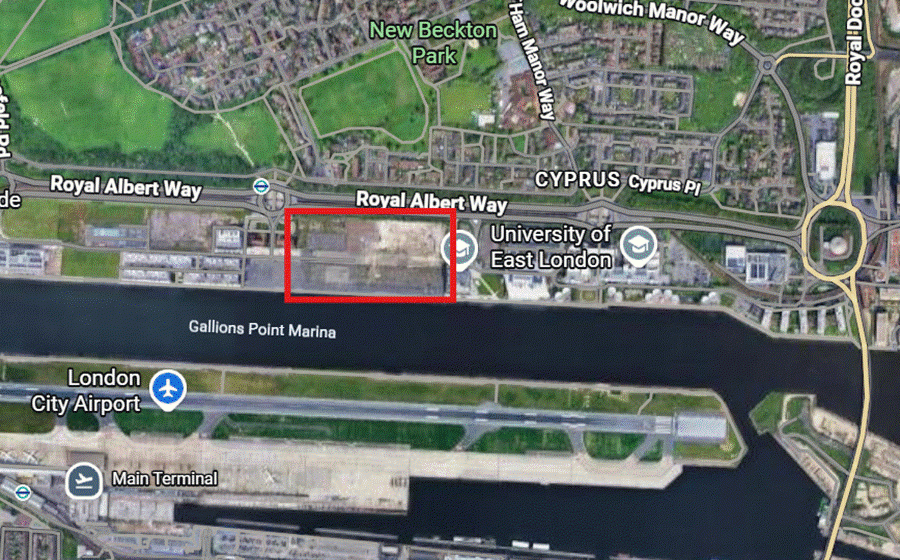
This problem is not unique to TfL land: it applies to public land across the capital. The Royal Albert Dock in East London is a barren concrete patch, with overgrown shrubs. Owned by the Greater London Authority, it has the capacity for up to 2,000 homes as part of a broader mixed-use regeneration scheme that could deliver 36,000 homes across the Royal Docks as a whole. It is located in an area already well connected by road, rail and air.[59]
Map showing the current development opportunity at Royal Albert Dock, East London
But despite these advantages, the site has failed to progress since the first phase of development was completed in 2019. Citing financial difficulty, the initial delivery partner was terminated in 2022 after failing to progress the site into the next phases of development.[60] The site has been promoted as a development opportunity since July 2025 and has yet to formally procure a master developer.
This highlights a broader issue: even where land is available and well-located, delivery barriers persist that can significantly delay housing supply and deter investment in areas of significant opportunity.
Building on public land in London is hard because of affordable housing requirements which are dependent on public subsidy
Under the London Plan, public land schemes must meet a 50% affordable housing threshold to qualify for the fast-track route through planning.[61] This is a 15% greater affordable housing requirement than on private land in London. Despite this more onerous requirement, public land is no more viable than private land, facing the same macroeconomic environment, and governed by the same planning framework.
The current rationale for this extra requirement on public land – apart from the fact that the state already owns the land, and the air rights above it – is that such developments are an opportunity to provide essential workers with homes close to their places of work.[62]
However, in making development less viable, these extra requirements lead to fewer homes being built. Policymakers who justify these extra requirements are failing to consider how a greater supply of homes, subsidised or not, would lead to lower house prices and rents for all workers, including essential ones, if this land was viable for development.
Affordable housing requirements mean that developers who are willing and able to deliver housing on public land are dependent on public subsidy to do so. Indeed, even if the state were to deliver its land at below market rate for the development of more homes, it would not resolve the difficulty of meeting affordable housing requirements. Even with zero land costs, meeting these requirements would require substantial state subsidy.[63] This is wasteful.
At Silvertown Quays, a 60-acre publicly owned site expected to deliver 6,500 homes, an £80 million subsidy from the Affordable Homes Programme will be required to support the affordable housing offer.[64] This is despite the site taking nearly two decades to progress, with delays driven by remediation and infrastructure costs, and despite having developers willing to deliver much needed homes on the site.
As an unnecessary additional pressure inhibiting public land development, public land should be treated the same as private land for required affordability percentages. The merits of the additional housing supply alone make the economic case for doing so, while aiding London to deliver its annual housing targets.
Many public land sites are small, which carry their own challenges
Small publicly owned sites dominate the development pipeline. Of the 20,000 potentially developable sites identified, only ~1,300 are over 20 acres.[65] So despite their scale, smaller sites remain important areas for housing delivery.
Many of these are able to benefit from an intensification of land use. Educational facilities across London’s municipal land, for example, tend to have surplus or underutilised brownfield, with ample connectivity and infrastructure.[66] This is incredibly pertinent in the capital, where families being priced out by housing shortages have put schools in the capital at risk of closure.[67] Acton and West London College is a successful example of small site public land being effectively densified to deliver 120 new homes on an underutilised school site, unlocked using a public street.[68]
But smaller sites remain subject to significant regulatory expectations and demands. And these smaller sites, like Acton and West London College, are simply not worth enough for larger housebuilders to redevelop – leaving SMEs at the mercy of the many taxes and regulations we cover in our section on brownfield land.
How to identify and effectively bring forward more publicly owned sites for housing
To enhance the pipeline of publicly owned land available for development, all public bodies should be required to produce an asset management strategy that identifies underutilised sites that are vacant, partially vacant, particularly below local average densities, or no longer required for their current public use. This should culminate in a rolling five-year optimisation pipeline of sites to be brought forward for development, disposal, or partnership, with clear delivery timelines and progress updates. Where authorities fail to deliver on these sites, or progress on applications stall, the Secretary of State should call these sites in for determination.
Where underutilised land is identified, policy should shift from viability-challenging expectations on affordable housing quotas to a presumption in favour of development to encourage and support housebuilding. Especially where public land assets are underperforming, serving suboptimal local populations to the risk of closure, or within 1km of a Tube station, there should bea clear presumption in favour of publicly owned land development written into the London Plan.[69] This would prioritise the intensification of public land through the provision of additional homes where they can sustain local services – including schools at risk of closure – and make best use of existing infrastructure. This presumption, essentially, must be paired with a reduced share of affordable housing requirements.
For larger sites there is another option: Crown Development Orders. The Housing Secretary should encourage larger public-owned sites to pass through the new Crown Development Order process, given that housing building in London is of importance to the national economy. That would shorten the time window by enabling developers to apply directly to the Secretary of State, who could jointly consent new public services alongside new homes.
Brownfield Land
Brownfield land is previously developed land. In a land-constrained city, shaped by low densities and Green Belt restrictions, derelict and empty brownfield sites present the opportunity to deliver housing in high-demand areas, with the capacity to deliver approximately five years’ worth of London’s housing targets.[70]
London has historically delivered most of its new housing on brownfield land. Between 2006/7 and 2020/21, the percentage of new residential development completed on previously developed land ranged from 95.7% to 99.8%.[71]
Policy encouraging the regeneration and intensification of brownfield land is explicit across national and London planning frameworks. The new National Planning Policy Framework puts substantial weight behind approving planning applications in already developed areas.
However, the NPPF will be less effective in London due to the variety of competing planning objectives that come with the redevelopment of brownfield land. The London Plan contains over 500 pages and 113 different policy areas; each of these are too often treated as absolute requirements rather than as guidance.[72] This creates a system in which policies conflict with one another, limiting rather than supporting the extent to which brownfield can deliver more housing.
The delay of Shoreditch Works is a key example. This is a brownfield development with an application swelling to 9,084 pages demonstrating compliance with 42 separate Hackney policies, 75 separate London Plan policies, and national legislation and guidance.[73] Among the reasons for the rejection are competing policy priorities. For example, the development will not deliver enough homes, because the borough of Hackney is already delivering too few homes. But the development must also be no higher to accommodate a greater number of units, because it is already too tall.[74]
To address this, a clear, strong presumption in favour of brownfield development within the London Plan should be introduced to streamline decision-making and resolve policy conflicts, as called for in the 2024 London Plan review commissioned by then-Secretary of State Michael Gove. This mirrors the language in the new NPPF, but also helps to resolve the conflicting policies, which can stymie development.
The London Plan should include the following presumption:
‘There should be a strong presumption in favour of granting planning permission for residential development on previously developed (brownfield) land within Inner London Boroughs.
‘Where a proposal meets this requirement, substantial weight must be given to the benefits of delivering additional housing in the capital. Planning permission should be granted without delay, unless the adverse impacts of doing so would significantly and demonstrably outweigh the benefits of development.
‘In applying this presumption, decision makers should take a flexible and proportionate approach to the application of policy requirements, including affordable housing, where it is clearly evidenced that such requirements would render development unviable or undeliverable.’ [75]
A presumption in favour of the development of brownfield land will not, on its own, go far enough to expedite the delivery of more homes in London. Brownfield sites are complex and capital-intensive: they require extensive remediation, added to by higher labour costs, and specialist contractor fees – alongside a steep 21.6% increase in landfill taxes in 2025.[76][77] These costs can only be recovered at sale.
There is too little financial relief to offset these costs of developing brownfield land, despite the public benefits associated with its development, including the remediation of contaminated land and additional new homes. Existing programmes, including the Brownfield Land Release Fund, have had little impact. The programme is applied nationally, utilising £68m to release enough land for 5200 homes; only about £12.4m went to London councils.[78] But such a programme applied to the scale of brownfield needed to develop London’s homes would be at significant cost to the taxpayer.
The Government should expand full expensing to cover brownfield regeneration projects. This would enable homebuilders to fully deduct their eligible costs, such as land remediation, infrastructure, and construction, in the year that they were incurred rather than spread across multiple tax years. Full expensing will unlock investment into bringing brownfield land back into productive use and lower financing costs without reducing overall tax revenue.
Biodiversity net gain is a key challenge blocking the delivery of homes on brownfield land
Biodiversity net gain (BNG) is a prohibitively expensive policy requirement that reduces the potential for homes to be delivered on brownfield land. Introduced by the Environment Act 2021, it insists that developments covering more than 0.25 hectares of habitat must contribute to a minimum 10% increase in habitats.[79] This came into force in early 2024 and is significantly disruptive on small sites.[80]
Applying BNG equally to London as to the rest of the country does not simply risk constraining development where land is already scarce, but ignores the economic and social value of delivering housing in the capital relative to the marginal ecological gain achievable in London.
London already has 3,000 parks and a network of diverse green and blue spaces to facilitate biodiversity.[81] Thwarting development on BNG grounds risks development spilling out into the countryside, incurring greater damage than if we allow London to build by exempting development from this restriction.
Further to the ongoing consultation considering a targeted BNG exemption for residential brownfield development, London brownfield should be exempt from BNG requirements.[82] Building homes on a disused car park in London creates far less ecological harm than building homes on green fields. Yet both of them have to go through expensive surveys and monitoring that can add thousands of pounds to the cost of delivery.
Environmental Impact Assessment screenings add unnecessary burdens to the development of brownfield land
Brownfield developments in London involving more than 150 homes, or an area of at least 0.5 hectares, are subject to environmental impact screening requirements that are unusually stringent by international standards. In practice, this can generate documentation running to over 100 pages, alongside costly and time-consuming consultation processes, before a determination is even made as to whether a full Environmental Impact Assessment (EIA) is required.[83][84]
While these requirements originate from an EU directive, the UK applies them far more stringently than comparable European countries. For example, in the Netherlands, residential developments typically only trigger environmental screening at a much higher threshold of 2,000 homes or 100 hectares.
This disparity imposes disproportionate costs on urban brownfield schemes in London, where sites are smaller and margins tighter. As a result, developers face significant upfront burdens even where the likelihood of meaningful environmental harm is limited.
For the whole of the UK, the Government should raise screening thresholds, particularly for brownfield development in high-density urban areas, reducing unnecessary administrative burden and maintaining robust environmental safeguards when they are most needed. This can be done under secondary legislative powers by the Secretary of State to reform Schedule 2, 10 (b) of The Town and Country Planning (Environmental Impact Assessment) Regulations 2017.
3) Making the most of existing properties
Giving homeowners greater choice
Much of this paper has been focused on finding sites for new, dense development. These sites will have a large role to play in delivering the homes that London needs. However, the truth is most of London’s developable land area, especially in outer London, is already built on by single-family homes.
Attempts to build more in such areas have faced backlashes in the past. Replacing some of these homes with flats would increase density, as seen in Croydon’s small site policy from 2019-2022. In this case, the council implemented a suburban design guide (SDG), which meant existing detached homes could be torn down and replaced by small blocks of up to 10 homes.[85] The policy was a success: housing delivery in Croydon doubled while the Suburban Design Guide was in place, outstripping other London boroughs. Housing also became more affordable as a result of the extra supply.[86] But this rate of development was unpopular with local residents. Ahead of the 2022 local elections, both the Labour and Conservative candidates for Mayor of Croydon stood on pledges to withdraw the SDG.[87]
Fortunately, there are better ways of building upwards while reducing the potential for political fights. Loft extensions enable an extra storey to be built on existing family homes. Extra rooms increase the flexibility of the housing market. Homes could grow upwards alongside a growing family, or the additional room could be let out to a lodger or friend. This extra space could also help a family member who wants to move to London to work or study, a parent who needs care, or a relative whose job requires them to be in London a couple of days a week.
Sadly, the current system of permitted development rights (PDRs) leads to smaller and less useful extensions. For example, any extension may not be higher than the existing ridge line, which means the new rooms have low, cramped ceilings. Likewise, extensions are limited to just 40 cubic metres of additional loft space for terraced homes and 50 cubic metres for semi-detached and detached houses.[88] That severely restricts the extra floor space that can be added, effectively eliminating the chance of adding two full double bedrooms.
The differences between an existing terraced home, the maximum current permitted development loft extension and a complete loft extension, also called a Great Green Loft. The green area on the right shows the potential uplift if we rationalised our permitted development standards (Source: Populo Living)
Extensions like the one above on the right have to go through the full planning process. Right now every local authority has their own rules relating to what sorts of extensions are allowed, which creates uncertainty and delay, and in many cases effectively bans these beneficial extensions.
To allow homes to grow up, the next Housing Secretary should amend existing permitted development rights to remove the cubic area restriction, give more flexibility around the ridgeline, and remove the arbitrary 0.2m set back requirement for where the loft starts.
In London, this tweak would provide the opportunity for between 450,000 and 900,000 additional bedrooms.[89] This would provide a huge opportunity for small builders who have almost completely been pushed out of London housebuilding. This scale of project could be managed by a local builder who will know the area and be proud to improve it.
Similarly, the previous Government consulted on changes to permitted development rights.[90] These included allowing larger and more useful extensions that rise to the roofline, better guidelines for loft extensions, and allowing permitted development rights to apply to older homes. But MHCLG has not made progress. The next Housing Secretary should implement the tweaks within the 2024 consultation which will allow Londoners, and the rest of the English, greater rights over their own homes. This will also enable more rear and side extensions.
One complicating factor is conservation areas. There are currently over 1,000 conservation areas in London. In some boroughs, like Camden or Hammersmith & Fulham, they take up half of the borough’s land.[91]
However, conservation area status should not lead to an automatic ‘no’ towards any development. After all, historically these areas would grow. The Strand, for example, started as a street of one- and two-storey buildings, before gradually expanding upwards to the six to nine storeys we have today. Similarly, it was common for Georgian or Victorian homes to have roof or rear extensions if the family living there needed extra space.
Tower Hamlets provides a good example of allowing expansion while respecting the conservation area status.[92] After campaigning by local residents, the council published guidelines permitting roof extensions within strict frameworks, and design guides meant to mirror traditional mansard extensions.
Examples of roof extensions within a Tower Hamlets conservation area that match traditional designs
Similar to the Tower Hamlets example, residents in South Tottenham demanded the ability to add space to their homes due to overcrowding. A new Supplementary Planning Document allowed the addition of all full storey and a loft extension while introducing visual requirements to ensure that the redeveloped properties matched the existing character of the neighbourhood. Over 200 households out of 1,000 eligible properties took this opportunity, which can pay for itself through the provision of valuable, extra floor space.[93]
The Housing Secretary should confirm that historically appropriate roof and rear extensions do not constitute a harm to conservation areas within the National Planning Policy Framework and that extensions are useful both for creating additional homes and for adding additional residential space. The latter point is important because L2.1.D of the draft NPPF currently only encourages expansion of existing homes if it leads to additional homes. This text should be updated to ‘additional residential space’ to not restrict current homeowners unnecessarily. And in learning from the Tower Hamlets and South Tottenham examples, the Housing Secretary should encourage local planning authorities to create design guides for acceptable roof and home extensions within and outside of conservation areas.
This work could be accelerated through a statutory national development management policy (NDMP). The Housing Secretary should issue a statutory NDMP creating a national ‘yes unless’ rule for household extensions that require a planning application, while narrowing the scope for local plans to impose inconsistent tests or damaging regulations. That would tip the balance in favour of home extensions, helping empower existing homeowners to make their properties the best for their families. Such an NDMP should also explicitly state the reasons why an extension could be refused, which could include cases of a loss of privacy, failure to meet building safety requirements, or damaging a listed building.
Finally, the necessary secondary legislation for street votes should be passed. This will allow homeowners in London even more flexibility about the future of their homes and streets. Should a supermajority of residents vote in favour of a plan for gentle intensification, they should be allowed to grant themselves planning permission and capture the large uplift generated.
Change of use
Increasing the supply of housing in London goes beyond just building more new homes. The next government should also look to increase the flexibility of the buildings that we do have already, whether it be the many disused shops on London’s high streets or office buildings that are no longer used after the shift in working patterns post-Covid.
One of the authors of this report lives in a converted factory. The site was a booming Victorian centre of production, but by the 1970s had fallen into disrepair before finding new life decades later. The conversion has successfully brought the site back into use while providing hundreds of homes.
However, since the successful regeneration, the guidelines have changed in a way that would make such a conversion impossible. Due to its listed status, the factory could not now be modified to provide private outdoor space to every flat. The size of the buildings makes following the dual aspect rules (which hold that flats should have light from two sides) almost impossible. Similarly, the London Plan’s housing design standards would make it complicated to retain the large windows of the original factory, and would frown on the north-facing orientation of many of the single-aspect flats. This example shows how new regulation often either adds costs to regeneration projects or blocks them outright.
The Mayor or the Housing Secretary should change the London Plan to scrap regulations that prevent conversions such as private outdoor space, dual aspect, and stringent accessibility standards.
The previous government expanded permitted development rights to make it easier to convert certain buildings into homes. However, this power is limited in London by both local councils and the London Plan. Local authorities are able to create Article 4 directions, which force these conversions to go through a full planning application rather than being waved through automatically. These are often used to force developers into paying Section 106 contributions towards affordable housing, which they would not have to do under PDRs.
Additionally, the London Plan discourages new housing in the Central Activities Zone, which encompasses most of Zone One, if it impedes on the commercial and office-based nature of central London. This clause is used to oppose the reuse of these spaces as homes.
To boost changes of use and increase flexibility in the buildings that we already have, the Housing Secretary should limit councils from creating Article 4 directions that stop easy conversions within central London. The Mayor or the Housing Secretary should change the London Plan to encourage housing within the Central Activities Zone.
When conversions are forced to go through planning, local authorities are able to further frustrate the process. Certain councils like Camden and Tower Hamlets require office space to be on the market for two or more years before a conversion is considered.[94] To force a property to be out of use for more than two years before even beginning the planning and construction processes makes these conversions uneconomic. The fact that the building owner wants to change its use should be proof enough that the market factors in favour of homes are stronger than those in favour of office spaces.
Finally, a statutory National Development Management Policy should be introduced to explicitly encourage conversions and to ban councils from requiring property to be vacant while awaiting a planning application for change of use. The desire of the property owner to change its use should be enough to demonstrate market demand.
Social housing
At 21.1%, London has the joint highest percentage of socially rented homes in England by region.[95] With 807,000 total social homes, London also has the highest absolute number of dwellings of any English region. Of all the OECD countries, only the Netherlands, Austria and Denmark have a higher percentage of homes that are rented out at subsidised prices.[96] Yet for all its ‘affordable’ homes, London is the least affordable of any of the regions in the UK and one of the most expensive cities to live in throughout the world.
The latest English Housing Survey puts the average London private rent at £368 per week, compared to £157 per week for socially rented homes.[97] That equates to £10,972 a year in implicit subsidy to each socially rented home, or £9 billion a year across all of London’s social homes. Socially rented homes in the capital are also larger on a per resident basis than privately rented homes, so tenants are paying less to get more.[98]
That subsidy figure is also an underestimate, because it does not take into account the amount that the Government spends on Housing Benefit or on the housing component of Universal Credit. The former has an average annual award of £11,087 and is awarded to 265,000 London households, which makes a total cost to the Exchequer of roughly £3 billion a year.[99] Unfortunately, there is no regional breakdown for the housing component of Universal Credit, but assuming the breakdown in regional spending is the same as housing benefit, a further £6 billion a year is being spent.[100]
Taken altogether, it is likely that the Government spends more than £18bn a year subsidising people to live in London. Given this staggering amount, and the dire housing shortage within London, is the current way that the state gives out social housing and subsidies in this country’s most expensive real estate market serving the national interest?
The commonly given justification is that social housing in London is provided to essential workers. But this is wrong. Just 59% of working age households in social housing are in any form of employment.[101] That’s compared to 85% of those in privately rented housing and 95% of households with a mortgage. Of all social tenants, one out of every six have never worked.[102] The push by councils like Westminster to award lifetime tenancies also cuts against the argument that social housing is for essential and low-paid workers.
There is also a political point here. The 2021 census showed that 47.6% of social housing in London is let to people who were born outside the UK.[103] This is estimated to cost British taxpayers £3.6 billion a year in discounted rent.[104] Now of course, a lot of the people will have since naturalised to become British citizens. But figures released by the ONS show that 120,000 social homes are headed up by someone who does not have a British passport.[105] That equates to 15% of all social homes in London. If you asked British workers what they want their tax money spent on, they would almost certainly not say that it should go towards subsidising new arrivals (especially non-workers) to live in some of the country’s most attractive and desirable areas.
The next Mayor and Government should want London’s social homes to be allocated fairly. While at the same time, the huge implicit and explicit subsidies that the state provides to households living in the most expensive city in the UK must be recognised and reduced.
Sell expensive council homes when they become vacant
As London’s house prices have risen over the past half-century, so too have the values of social homes in the capital. This can lead to absurd outcomes, like million-pound council homes.
Social housing should not be a lottery for subsidised mansions. Buying a million-pound home would involve mortgage payments of roughly £4,500 a month, yet the median social tenant in London only pays £550 a month in rent.[106] That means that the subsidy for such properties could be as high as £50,000 a year.
There is a way to solve this unfairness. The Housing and Planning Act 2016 gives the Secretary of State the power to mandate local authorities pay a sum equivalent to the amount of higher-value vacant council housing that comes up each year. In other words, it provides local authorities with a strong incentive to sell valuable council properties when they become vacant. The legislation also mandates that the revenue from such sales should go towards building more, better-value social and affordable housing.
The Housing Secretary should use this power to force the sell expensive social housing, with proceeds spent on building more homes for affordable rent. Expensive social housing should be defined as any social home that is valued at more than the London average price for a property with the same number of bedrooms.[107] Before the 2016 Act, ministers suggested what these amounts might be in London.[108] Adjusting for house price inflation, the numbers provide an indication of what higher-value council housing should be sold off once it becomes vacant:[109]
1-bed: £400,000
2-bed: £460,000
3-bed: £570,000
4+ bed: £910,000
Savills estimated in 2015 that such a plan, implemented across the country, would raise £3.2 billion from 5,500 annual sales, with London contributing the most valuable properties.[110]The money raised from the sale of these expensive properties can then be recycled into the construction of affordable homes to help tackle London’s growing number of people living in temporary accommodation.
A national cap on housing benefit
Housing benefit and the housing component of Universal Credit have become enormously expensive. Taken together, Great Britain is spending £37.3 billion on housing subsidies, which is by far the highest amount in the OECD as a percentage of GDP and almost double France, which is the next highest spender.[111]
One reason for this high expenditure is that housing benefit is meant to cover the cost of rent for a property in the 30th percentile of market rates within a claimant’s local area. A claimant in Central London is entitled to four and a half times as much in housing UC as claimants in Durham when renting a two-bed property.[112]
In addition to the staggering cost to the taxpayer, the current policy distorts the housing market. There is no incentive for claimants to move to cheaper areas, as the only result is a decrease in their benefit claim. Likewise, claimants are subsidised to live in areas with dire housing shortages, which drives up prices and rents. That harms working people who are not on welfare.
The next Housing Secretary should impose a national cap on future Universal Credit housing claims set at the median national rent. That would mean future claimants would receive either the 30th percentile rent in their Broad Rental Market Area or the median national rent, whichever is lower.We should not be subsidising people to live in properties that are more expensive than what the average British family can afford. Existing claimants should be grandfathered in on their existing rates to avoid any unfairness. But we would no longer be subsidising new claimants to live in the most expensive areas, while reducing Britain’s eye-watering welfare bill.
Revive the Right to Buy
We should want both to encourage property ownership and for social properties to bear the full weight of the implicit subsidy that they receive so that the homes go to the people who value them the most. Ownership is desirable both as an end in itself and as a means for individuals to gain a stake in their local community.
Ownership also has the added benefit of potential productivity increases through win-win transactions. Existing social tenants may feel that their home does not match their needs any more, or perhaps may want to cash in on some of the equity in their home by moving to a cheaper area. Likewise, perhaps a family may want to move to London to make the most of the job opportunities.
There’s a genuine win-win outcome here, where both the existing social tenants are better off and the buyers of the home are happy too. These win-win outcomes are only possible under the current system because of Right to Buy – yet the current Government has announced that it is clamping down further on Right to Buy, for example exempting newly built social homes from being eligible for 35 years.[113]
Right to Buy has already helped two million families own their home. Reviving and expanding it would boost home ownership and give millions more a foothold on the property ladder.
The most basic step in improving the existing system is to reverse Labour’s changes to the Right to Buy and expand the existing Right to Buy from local authority tenants to housing association tenants as well. That would more than double the number of London social rent households who have the ability to buy their own property.
But to go further, the next Housing Secretary should introduce a new and better version of the Right to Buy, as proposed by Alex Morton for the Centre for Policy Studies.[114] This would see every housing payment, excluding housing benefit, go towards paying off a mortgage secured against the property. A mortgage worth 60% of the value of the property would be secured on the property, backed by the government. Repayments would be set at the rent the year the mortgage was taken out, with the housing payments rising as social rents do (currently CPI +1%). The increase above the starting payment functions as the ‘interest’ payable on the mortgage.
Then as the tenant makes payments, they would build up equity. Once they paid off their 60% mortgage, they would obtain full ownership of the property. The existing equity could also cover housing payments if the tenant lost their job or had a change in personal circumstances. This would encourage more flexibility over the use and allocation of social properties in the future compared to the present system. The full details of this scheme are beyond the scope of this paper but can be found in Alex’s report.
This version of the Right to Buy has four main advantages for tenants compared to the existing right to buy system that makes it more attractive for gaining ownership:
The tenant has support if they lose a job or a relationship breaks down. Under the existing right to buy system, they run the risk of being dispossessed if they fail to keep up with mortgage payments.
The local authority or housing association would continue to cover large scale maintenance costs, while the resident would cover minor maintenance costs around their home like blocked sinks or broken appliances.
This system still enables access to housing benefit, although those payments do not go towards building up equity. The lack of housing benefit is a big disincentive to go through with a right to buy purchase.
And finally, initial costs are lower for the resident. Mortgages are most costly at the start given the bulk goes towards paying off interest as equity slowly builds. That provides a helpful boost for households to get on the housing ladder.
4) Policies and Regulations
In the previous two chapters, we have pinpointed specific areas where London should build, as well as outlining how we can make better use of the existing housing stock and spur extensions, densification and a better allocation of housing stock, in particular by ensuring that London is home to more homeowners and productive workers.
But there are a whole range of other policies, set at both local and national level, that need to be improved, from the inadequate housing targets set for London to the affordable housing targets that burden viability.
In this final chapter, we will examine those issues, before taking a granular look at the precise regulations that need to change at both a local and national level, and the role played by the infamous Building Safety Regulator.
Reforming housing targets to spur delivery
The Government has revised and strengthened the system of housing targets. But where they remain unmet, as is too often the case in London, they become meaningless.
London is building nowhere near its housing target. Between 2021-2024, London built just 36% of its old, planned 99,000 homes a year target on average. Every single other English region managed far more building compared to its target, with the average region building 94% of its goal. The East Midlands, North East, North West, and Yorkshire all exceeded their targets.[115]
In fact, London has not built close to its new target of 88,000 homes in a year since the 1930s. Partly this is because, even when national targets are increased, the impact in London is limited.
Borough housing targets are not set directly by the national standard method, but by the London Plan, which in turn is used to inform borough plans. The current plan was published in 2021 when London’s housing target was 52,000 homes a year.
The new London Plan is not expected until 2027, potentially 2028. This enables boroughs to continue undercutting their share of the new target for the foreseeable future as local plans are able to be locked in for five years. This exposes London to a significant risk of underbuilding by tens of thousands each year even with proposed reforms to the housing targets and policies that would expedite planning permission. A solution is to ensure that as national targets increase, each borough increases its contribution in proportion to its current share of the target.[116]
That said, targets only matter if there are consequences if a local authority fails to build. Without credible consequences for under-delivery, local authorities may simply plan for fewer homes or slow approvals in response to political pressure from local residents. Across the country, it is common that local authorities miss their annual housing targets. But in London, councils missing their targets compounds into significant losses for the capital.
In 2025, it was found that 10 London boroughs delivered less than 75% of their annual housing targets under the Housing Delivery Test. In the first quarter of 2025, 23 of the 33 boroughs across London recorded zero new housing starts.[117]
London councils are also the least likely to decide an application on time. Only 12% of major planning applications were decided within the initial 13-week target in London, the worst performance of any region, and well below the English average of 20%.[118]
To prevent this from happening and to ensure new homes are delivered across the capital, local authorities should be penalised for not meeting their housing targets where applications have been submitted. The planning system already contains mechanisms that could support stronger enforcement. The Housing Secretary should use their powers under s62A-B of the Town and Country Planning Act 1990 to designate underperforming London councils. That allows applicants to choose to apply for planning permission directly to the Planning Inspectorate, rather than waiting for a response from a council that is already missing its planning decision goals and housing targets.
There are more policy levers to build homes in areas that are underperforming their targets. The Housing Secretary could choose to use their powers under s15GA of the Planning and Compulsory Purchase Act 2004 to revise the local plan of underperforming London councils. Additionally both the Mayor and the Housing Secretary have powerful call-in powers which allow them to review and approve planning applications as they see fit. If there are significant housing or commercial developments that risk rejection or delay, the Mayor or the Housing Secretary should use their call-in powers and approve them.
The Government’s new housing target understates the number of homes needed in London
In 2024, the Labour Government introduced a new standard method to calculate housing targets. London is the only region where housing targets fell, from roughly 99,000 homes a year to 88,000. All other regions saw their targets rise. Given that London has the worst housing shortage of any of the regions, a reduced target is completely illogical and exposes an inadequate allocation mechanism.[119]
The revised housing need method calculates targets in two stages. First, a baseline need is set at 0.8% of existing housing stock. Second, this figure is increased where housing is less affordable, using the house price-to-income ratio averaged over five years. While this affordability adjustment increases targets in expensive areas, London’s overall target fell compared with the previous method because the baseline calculation is now tied to existing housing stock rather than higher population growth projections. But in a city which has historically had housing delivery significantly lag behind population growth, the housing stock is an insufficient baseline.
A better approach would allocate homes according to median house prices minus bare construction costs. This method reflects a core market signal: where the gap between prices and build costs is large, there is strong demand and weak supply, and more homes should be built.
Housing targets should be set according to median price to build cost ratios, based on local authority house price data and estimated basic regional construction costs, multiplied by average floor area.[120]
This approach would ensure London absorbs a greater share of national housebuilding. London currently absorbs 22% of the national housebuilding target. Under the new method proposed, London’s annual housebuilding target would rise to 145,000 homes, representing 39% of national housing delivery.[121]
This will significantly increase the housebuilding targets applied to London and its individual boroughs. It will equally reduce the pressure on councils across the country, where demand is lower and less economically viable. Of course, there will still be a need to build homes in these areas – but this metric will be more sympathetic to the local economic circumstances.
Our housing targets let London off too lightly
Other regions have to build more than their share because the capital builds less.
Affordable housing requirements and developer contributions
The London Plan expects that every private housing development has 35% affordable homes.[123] High affordability requirements might sound like a way to deliver more cheap housing – but they actually function like a tax on new development. When the Mayor or councils mandate that a given share of new homes must be let or sold at below-market prices, the cost of construction does not vanish. Instead, it is shifted onto the developer, who will then pass the cost on to the remaining market-rate homes.
In practice, this reduces the financial viability of projects, especially on marginal sites, and deters new supply. The effect is the same as imposing a tax: it makes building more expensive and less likely to happen. If a building cannot meet the 35% requirement, there are viability assessments, which can be used to allow a development to proceed with a lower contribution of affordable housing if a higher share would simply make the project unviable. But these mechanisms are neither automatic nor frictionless. They typically involve lengthy negotiations and complex financial disclosures which are difficult to predict in a turbulent market – while still carrying the risk of refusal. Countless large schemes have been held up or rejected by this hidden tax.
We call this a tax, because the cost is borne by working people who are forced to pay more for housing as a result. It is also borne by landowners in the form of lower land values, and developers in squeezed margins, which strongly discourages them from building homes in the first place.
Taken together, this is wealth redistribution through the planning system rather than through transparent public spending. If the government wants to build more subsidised housing, it should pay for it out of general taxation, not the distortionary affordability targets.
Even Steve Reed, as Housing Secretary, acknowledged that affordability requirements block delivery. After London’s annual housing starts dropped to fewer than 5,000, Reed ordered Sadiq Khan to temporarily lower the affordable percentage from 35% to 20% on most sites. The associated consultation said that ‘reducing the affordable housing thresholds…is designed to encourage development to come forward’.[124]
These are welcome steps, but they do not go far enough. And as mentioned above, if these measures will get more houses built, why are they temporary rather than permanent?
Moving chains means new market rate housing benefits households of all incomes
Building more market-rate housing obviously benefits the people who move into the new homes. But the benefits ripple out further.[125] The buyers of a new home move out of their existing house, which frees it up for someone else to move in to. That in turn frees up another home. This chain of moving can stretch across income divides. One study in Helsinki found that 55% of these chains reach households in the bottom half of the income distribution and 36% reach households in the bottom quintile.[126] Another in Switzerland found that for every 100 new market-rate homes, there were 75 household moves among those below the median income.[127] Put another way, the benefits of new construction helped working class families move into a better home 75% of the time.
An illustration of the moving chains that new supply opens up, which allow for moves across the income distribution and help to reduce overcrowding among the worst off (Source: Hauck and Kluser)[128]
Supply and flexibility are what matters. If there’s anything close to an iron-clad law of land economics, it is that increasing housing supply makes housing more affordable.[129] Homes England estimates that a 1% increase in the housing stock leads to a 2% reduction in house prices.[130] By reducing the viability of new supply, affordable housing requirements can actually reduce affordability across the whole housing market.
Affordable housing requirements severely limit who is eligible
As mentioned above, most Londoners will see no benefit from new subsidised housing. The system prioritises acute distress rather than ordinary low-paid work. The result is that many working households are stuck in the worst of both worlds: too secure to reach the front of an ever-lengthening queue for social housing, but nowhere near affluent enough to comfortably afford the market rent, let alone get on the housing ladder.
A defender of social housing might suggest that intermediate rent properties, a subset of affordable housing, are more appropriate for working families. Yet, distortions in intermediate rent properties can lead to absurd outcomes. For example, one three-bed intermediate rent flat in the City of Westminster requires a minimum household income of £82,600 to be able to afford the rent, but a maximum household income of £90,000 to still be eligible for reduced rent – and the household cannot have more than £100,000 saved.[131] Having such a narrow eligibility range is farcical, rewarding people with inside knowledge of the allocation system at the expense of working families.
The next Mayor of London or Housing Secretary should remove affordability requirements from the London Plan. This will spur more construction, unlock marginal sites, and with the filtering effects mentioned above provide more affordable housing for households across the income spectrum.
This should not prevent the central government, local authorities or housing associations from building their own subsidised homes if they would like. Similarly, there should be no restrictions on central government, local authorities or housing associations from partnering with developers to purchase a percentage of homes and subsidise them. But funding for this should come out of general taxation, not distortionary requirements.
Importantly, a significant percentage of the savings from removing the affordability requirements could and should go towards the provision of additional local and regional infrastructure. Contributions towards infrastructure mitigate the harmful externalities that new development brings, such as more congested transport networks. In turn, the provision of infrastructure can drive sales for new housing developments, as with the Tube extension to Battersea Power Station and Nine Elms.[132]
Indeed, beyond the subsidised housing percentage, the whole framework of land value capture needs to be improved. London’s developer contribution system should be simplified and turned into a unified Infrastructure Levy, excluding affordable housing contributions. This should be based on a share of development value and replace the current fragmented system, with revenues split between boroughs and the Greater London Authority to support both local and strategic investment. This would reduce delays, improve certainty, and ensure that developer contributions are more productively deployed.
The existing system is a primary source of delay to the delivery of new homes. The average time to reach an agreement between developers and local authorities across the country in 2024/25 was 515 days.[133] In London, around 50,000 homes consented between 2019 and 2025 had not started construction due to Section 106 delays.[134] Rather than case by case negotiations, there should be clear contribution formulas devised with industry to simplify and expedite contribution agreement decisions, instilling greater certainty into the system.
The legal powers to introduce the system in principle already exist. The Levelling Up and Regeneration Act 2023 provides the Secretary of State with the secondary legislative power to introduce a national Infrastructure Levy to replace s106 and CIL. A London-wide levy could be implemented within this framework.
Remove late-stage reviews
Another benefit of removing affordable housing requirements and simplifying value capture is the removal of late-stage reviews (LSR). LSR mechanisms allow authorities to capture additional developer profits where schemes outperform expectations – but offer no equivalent downside protection to developers who suffer amid the boom and bust of London’s housing market.
In effect, LSRs mean that local authorities and the Mayor capture most of any unexpected upside, while the developer carries the burden if the scheme faces any unexpected challenges. Put another way, heads the local council wins, tails the developer loses.
In the volatile macroeconomic conditions London finds itself in, characterised by construction cost inflation, higher interest rates, poor sale value growth, and delay after delay in the planning system, this asymmetric risk allocation is a disincentive to invest capital into housebuilding projects in the capital.[135] LSRs also add to the cost of capital: the very investment required to fund housing delivery may demand a greater return to compensate for the risk, which ultimately could kill bids altogether by making the development unviable.[136]
Late-stage reviews should either be removed and the initial agreement between the council and developer be maintained, or allow for downwards renegotiation if market conditions worsen after the initial agreement.
London Plan Rules
The London Plan 2021 is 542 pages, covering 113 policy areas. Each of these areas has individual policies associated with them, which taken together provide 541 different policies that applications can be assessed against.
There are many worthwhile regulations in the London Plan. It is right that we should use regulation to make well-functioning markets to internalise costs, guard our heritage and green spaces, and give homebuyers the assurance that they are buying well-made and safe new homes.
But the system as it stands is not working for anyone.
The London Plan’s policies, and housing regulations in general, can be divided into two categories. The first addresses genuine externalities, where new developments impose costs on others without compensation: noise, lost daylight, impacts on public services etc.
The second category, however, regulates costs that the developer and future occupiers already have every incentive to optimise themselves. A buyer who wants private outdoor space or a dual-aspect flat can simply refuse to pay for homes that do not meet these standards. Developers, who want to sell their houses, already have a commercial reason to deliver homes people want. Layering planning rules on top of these market signals does not correct a market failure. Rather, it overrides personal preferences, while reducing overall supply by pushing up construction costs and making sites unviable.
There are many regulations in the first category that we would amend. But as a priority for a new centre-right Government, we suggest that many if not most regulations in the second category should simply be eliminated, and replaced by a focus on the external impacts of construction. Indeed, New Zealand has explicitly adopted this externalities framework as the legislative basis for what planning can and cannot regulate. Their 2025 Planning Bill explicitly bans officials from restricting the internal layout of a building, dictating the provision of private outdoor space, or introducing tests of financial viability, among other examples.[137]
The reason for this is simple. Each of these regulations functions like a straw on a camel’s back. Alone, they are easily managed by developers, and can even sound nice and sensible. But taken together, they impose significant costs that have held up the construction of much-needed new homes.
Some of these regulations even directly contradict others. For example, ventilation regulations and dual aspect requirements assume that windows are open to get a cooling draft. However, to meet noise regulations, buildings are assumed to have windows shut. Likewise, daylight requirements push for larger windows, while overheating guidance pushes for smaller windows.
Steve Reed already recognised that some of the regulations in the London Plan are too burdensome in his emergency measures for London housebuilding. Gone are dual aspect requirements, limits to the number of homes per core, and over-provision of cycle storage.[138] These harmful regulations must not be allowed to be revived in future London plans.
But Reed’s de-regulatory push did not go far enough. Even with the removal of some of the most damaging regulations, the London Plan still weighs in on issues far beyond the reasonable level of regulation, with the result being fewer homes that cost more to build.
As the current Mayor prepares his second London Plan and the challengers in the 2028 Mayoral election start to think about what they may include in their own versions, it is worth studying the current plan to pull out regulations that are driving up costs and slowing down building.
Private outdoor space (D6.F.9)
If you look at recent new build developments in London, one of the most striking things about them is the preponderance of balconies that have been bolted on to the side. The reason for these balconies has not been an upswell of Londoners demanding them, but rather the addition of a policy in the London Plan to mandate a minimum of 5 square metres of private outdoor space per new home. The amount of outdoor space required rises as properties get larger.
Balconies or other private outdoor spaces are nice-to-have and many people would prefer to live in a place with one. However, this is not simply a costless regulation. The private outdoor space requirements are estimated to add between £10,000 and £20,000 to the cost of constructing a new home.[139]
Private outdoor space requirements have broken the façade of this new building while adding thousands of pounds to the construction cost of each of the flats.
While many people may like a balcony, when given the option of having to pay that much more for it, it’s less clear that they would be willing to pay for it. After all, some of the most expensive and beautiful areas of London – like Mayfair, St James’s and Marylebone – tend not to have private outdoor spaces. Likewise, quintessential London architecture like mansion blocks rarely provide 5m2 of private outdoor space, yet will still have significant buyer interest – especially if it is near to a park anyway.
This rule is especially damaging for conversions. Older buildings or office spaces were not designed to have private outdoor spaces, and as such, this regulation can significantly impede changes of use.
If people want to pay more for a balcony, housebuilders will build flats with balconies. If people would prefer not to spend £10,000 or more on a balcony, then they should be allowed to buy flats that do not have private outdoor space mandated.
Minimum space standards (D6)
Research from the GLA shows that the average renter in London consumes just 24.6m2 of space.[140] London flats are the most expensive in the country so it is not surprising that renters are not willing or able to pay for more space. Yet the smallest flats that can be built under the London Plan are 37m2 for an individual or 50m2 for a couple. That means the minimum space standard is 50% larger than what the average renting Londoner can afford. The Centre for Cities points out that this extra 12m2 is almost exactly equivalent to the requirement to have a sofa and TV area from the London Housing Design guide.[141]
The current minimum space standards restrict the options that renters have. Perhaps a young professional would like to live alone in her own flat, but there are not any at the size that she can afford. Because of the minimum space standards she is forced into a crowded flat-share. London’s 37m2 is also above similar countries. France, Spain, Italy, the Netherlands, and Japan all set the figure at 25m2 or below.[142] The London Plan should be amended to follow suit.
Housing size mix (H10)
The London Plan requires developers to deliver a range of unit sizes, which is meant to be supported by local evidence of need or the London Strategic Housing Market Assessment. There is no reason why the London Plan has to weigh in on this and inadvertently distort the housing market. Developers are already very well-incentivised to deliver housing sizes that they think there is demand for. If they didn’t get the size of homes right, they are less likely to be able to sell them and make a profit.
Concerns about developers only building one- or two-bedroom flats are misplaced. If there is more demand for such flats, then developers should be allowed to build to meet it. Right now, when developers are not allowed to build enough one or two bed flats to meet demand, that demand does not go away. Instead it manifests in the conversion of existing ‘family-sized’ terraced houses into flats. To reduce this trend, which is unpopular with neighbouring residents, local authorities and the GLA need to avoid restricting what types of homes can be built.
Affordable workspace (E3) and affordable student accommodation (H15.A.4)
When building either office space or student accommodation, the London Plan requires a significant percentage to be given away at a rate far below market level. The affordable workspace policy caused significant amounts of confusion during the planning committee deciding the Shoreditch works scheme and was one of the reasons that it was deferred, rather than approved.[143]
This is unlike almost any other type of transaction. A baker doesn’t have to give away a percentage of their bread. Plumbers can expect to be paid a market rate each time they’re called out. Pubs don’t have to provide some of their pints at a loss. Workspaces and student accommodation should be no different.
The current system also functions as a handout to less efficient businesses at the cost of actually increasing affordability across office spaces. If a business does not earn enough revenue to pay for its expenses, it should be allowed to go bust and be replaced by a more productive enterprise, not given a handout at the expense of the developer. As mentioned above, more supply leading to lower rents and land costs is as close as one gets to an iron-clad law of urban economics. By adding subsidy requirements, the London Plan is specifically making it more expensive to deliver this new supply.
Car parking restraints (T6)
The London Plan imposes restrictions on the amount of car parking that developers can include. This may make sense for central London, but it means that schemes in outer London do not have the level of car parking that future residents would like. In turn that makes it harder to sell the properties, which disincentivises the building of new homes in the first place.
For a lot of outer London, the standards mean that not every flat is able to have its own car parking space. When 45% of workers commute via car and 38% of all journeys are made in a car, not having a parking space is a significant disincentive to buy a house.[144] The way to encourage public transport uptake is to make public transport better, not to level down the ability of households to have a car.
(We should also, as mentioned above, ensure that the temporary relaxation of restrictions on cycle space in Steve Reed’s emergency plan becomes permanent. In a world in which electric bicycles literally litter the streets of London, it seems increasingly silly to mandate that every building fill its ground floor or basement with bike racks.)
Minimising greenhouse gas emissions (SI-2)
London residents already have the lowest greenhouse gas emissions of any region in the UK. This is driven by dense urban lifestyles with lower transportation and heating emissions. The London Plan’s requirements to reduce emissions by 35% beyond Building Regulations go past the point of diminishing marginal returns. Every new building in London will already be energy efficient, certainly far more than buildings that they replace. By requiring ever higher standards, new buildings become more expensive to build, leading to fewer of them, and an increased reliance on older, less-efficient buildings.
Accessibility (D7)
Part M of the Building Regulations lays out accessibility standards for housing. The London Plan chooses to go above and beyond the basic standards. It dictates that at least 10% of dwellings must be wheelchair user dwellings, which is reasonable as this level of accessibility might not be provided by the market. Yet the other 90% of dwellings have to have the second highest standard of accessibility.
This standard, M4(2), requires step-free access and additional circulation and layout requirements. As a result, many beloved London housing forms are impossible. Narrow, terraced homes cannot meet M4(2) because of the requirements to have wide staircases. Walk-up mansion blocks cannot be built because entrances have to be level without steps. Conversions become more difficult because the existing buildings were not designed with this level of accessibility in mind.
A mansion block like this cannot be built in London today, partially because of accessibility requirements, despite its popularity with potential residents as seen by its £1 million flats (Source: Winkworth Maida Vale)[145]
With London’s small, brownfield sites, this level of accessibility is often excessive. We should want the provision of wheelchair-accessible housing, but the requirement to make every home step-free adds more costs than the benefits it produces.
National Regulations
Second Staircase rules
While not in the London Plan, second staircase requirements are among the most damaging regulations introduced recently on new housebuilding in London. Announced in 2023, the rule mandates that all buildings taller than 18 metres, or six storeys, have two staircases. The official impact assessment found that the costs of this regulation would be 294 times the benefits.[146] Yet as the Centre for Policy Studies showed, even this was a very significant understatement, because the assessment assumed that builders could make buildings taller or wider to offset the floorspace reductions from the second staircase.[147] Given the constraints set by our planning system and the London Plan, these offsets are rarely feasible.
Putting in two staircases raises costs for buildings by reducing the amount of floorspace that can actually be lived in, while increasing complexity in construction. In many cases, to add a second staircase requires removing a flat from each floor of the building, which meaningfully reduces the number of homes a development provides. One estimate suggested that 18,000 homes a year are not being built because of the second staircase requirement.[148] That’s made up of projects that are no longer viable, a flat being dropped from each floor, or developers shrinking their buildings to keep them below the 18-metre threshold.
In one case, Pocket Living, a developer, had plans to build 50 flats on a plot in Hackney. After spending £1 million on the site and its planning application, the introduction of the second staircase rule made delivery unviable due to site constraints. Instead of those flats, a mortuary will be built on the site.[149]
The costs of second staircases are especially high for buildings between 18 and 50 metres. Yet the impact assessment predicted that lowering the threshold under which they are compulsory from 50 metres to 18 would not even save a single life over its 70-year modelling period. At the same time, this rule would impose £1.8 billion in costs. The result was that for buildings between 18 and 50 metres, the costs end up outweighing the benefits by more than 1,200 to 1. It is unsurprising that other countries, like France, Germany and Ireland, all chose 50 metres or above as their single-stair height limit.[150]
The next Government should raise the second staircase height limit to 50 metres. This is especially wise given that new lift regulations reduce the need for firefighters to use stairs during a fire in the first place.
Parts F, L, O, and S of the Building Regulations
The last Government introduced several changes to national building standards, with Net Zero being one of the central rationales. The main changes updated Part F, which deals with ventilation, and Part L, which covers energy efficiency and conservation. Ministers also introduced Part O, which handles overheating, and Part S, which deals with the provision of electric vehicle charging.
These regulations have added significant cost to construction. The Building Cost Information Service (BCIS) estimates that taken together, Parts F, L, O, and S have added 7.4% on average to the cost of construction for a new home since 2021.[151] Combined with surging material costs and the regulations mentioned above, these changes have made new homes less viable.
Part O in particular has restricted the quality of new construction. Air conditioning is treated as a last resort for cooling, instead of a go-to way of dealing with overheating. Part O also forces either a smaller glazing area or expensive dynamic thermal modelling and mandates a height of 1.1 metres above the ground. These combine to make for significantly smaller windows and effectively ban sash windows.
Age of the property is the biggest single factor in energy efficiency of homes. Just 12% of homes built before 1900 in England have a high energy efficiency rating, compared to almost all homes built in the past decade.[152] New buildings with modern insulation will always be more energy efficient and emit less carbon than older buildings that they replace. Making it more expensive to build modern buildings limits the carbon emission savings while also encouraging older buildings to remain in use.
With this further strengthening of the building regulations, the Government has increased the cost of construction at the same time as macroeconomic inflationary pressures are driving up costs. By making it more expensive to build new homes, these policies mean less building, and more reliance on older, less-efficient buildings. The next Government should loosen Parts F, L, O, and S of the building regulations to lower the cost of construction and bring forward more homes.
The Building Safety Regulator
The Building Safety Regulator (BSR) was created with noble intentions. Established by the Building Safety Act 2022 following the Grenfell Tower fire, its purpose is to strengthen oversight of building safety and restore public confidence in high-rise residential construction. But it has instead dramatically slowed down housebuilding by increasing uncertainty, adding delays, and making many new homes in London unviable.
The biggest two risks for building fires are the age of a building and overcrowding. This is especially true in London, where demand is high, overcrowding is a significant risk, and a third of unsafe buildings are concentrated. New buildings reduce all of these hazards, but the BSR has stymied new supply.
The BSR has resulted in uncertainty, delay and capital constraints
The BSR regime introduces substantial uncertainty and costs into the development process through its Gateway system. This is a three-stage approval process designed to ensure safety compliance throughout the development lifecycle which instead incurs significant delays.
This challenge is most acute at Gateway 2, which requires detailed safety documentation of consented developments to be reviewed and approved by the BSR before construction. The exact requirements of this documentation are uncertain, forcing developers to overprovide and, through no fault of their own, clog the system. In 2025 it was reported that 75% of submissions progressing through Gateway 2 were rejected owing to missing or flawed information.[153] And this comes at a significant cost: developers report spending between £12,000 and £25,000 on applications that were later rejected.[154]
Although statutory timelines suggest delivery should happen between eight and 12 weeks, actual decision times have often been far longer. Median processing times are approximately 43 weeks overall and around 48 weeks in London.[155] These delays reflect the regulators early stage learning curve, staffing constraints and multi-disciplinary assessment requirements, and industry adaptation to a new and complex safety regime.
The consequence of this Gateway has been a brutal shortfall in the annual delivery of homes for Londoners. The number of homes in the capital above 18m between 2019 and 2025 that had received full planning permission but had not yet started construction was 139,000.[156] This represents not just fewer people who will have a home in the capital, but a growing share of people who will face overcrowding in unsafe, older, lower-quality accommodation as a consequence of bureaucracy.
The introduction of the BSR has also distorted development heights across London. Developers are avoiding mid-rise schemes that fall within the regulatory threshold, of 18m or six storeys. Instead, projects either remain below 18m or seek significantly greater heights given that the economics of high-rise construction can justify the greater cost of compliance. This has had a direct impact on the ability to deliver a greater share of homes across London through gentle density; either new builds are short, or towers are built but are scattered across the capital.[157]
Reforms have been introduced to alleviate the backlog, but they have not resolved the underlying delays within the Gateway system. Reforms have included increasing the BSR’s staffing and technical capacity, introducing fast-track approval routes, more thorough guidance for developers to improve applications, and restructuring the body as a standalone regulator. Only three legacy cases are now in the backlog of Gateway 2.[158] But all new developments must still individually progress through Gateway 2, which remains liable to delays.
A new risk to the delivery of homes in London is Gateway 3. This stage is required for constructed and renovated high risk residential buildings to be checked before occupation can legally begin, meaning developers cannot release equity and must continue to service borrowing while awaiting approval. But similar delays are arising and, as of January 2026, no new build high risk developments had yet applied for Gateway 3 approval.[159]
The cumulative impact of the Building Safety Regulator is a legacy of declining viability. Developers have reported incorporating risk into their project timelines accounting for delays of up to 15 months beyond planning permission. Simultaneously, the BSR has worsened access to finance: according to industry, developers are struggling to access project funding until they have cleared Gateway 2. These issues can render projects unviable feeding into the decline of housing starts between 2023 (when the BSR came into force) and 2025.[160]
As long as the Building Safety Regulator has the sole duty to enforce regulatory standards across individual applications, there is a risk of delay, and slowed delivery of homes. This creates a structural bottleneck for the regulator: as applications increase, as they must for the delivery of more homes, the system will once again face backlogs. A more effective model would be to introduce an economic incentive for building safety that moves away from a case-by-case system toward industry-level risk reduction achieved through the market mechanism.
One explorable option could be an insurance model for what are currently designated as ‘high-risk buildings’. In this instance, the government could introduce an alternative route to the BSR, through a risk-based insurance framework for high-rise development construction. Developers would be required to hold comprehensive fire liability insurance, with strict fire liability for defects that compromise safety. The premium that the developers must be responsible for paying becomes the price of risk: better detailing, safer materials and proven contractors lower the price, and poor practice raises the premium.
Insurers – owing to their incentive to minimise risk and need for predictability – would play a central role in scrutinising building design, materials and construction practices before insuring projects. By establishing a market, this would create a faster, more efficient layer of oversight that incentivises developers to comply with regulation rather than relying on a strictly centralised approval process which is delaying delivery. Another approach, perhaps complementary, would simply be for the next Government to raise the height of buildings covered by the BSR regime, ideally to the 50m threshold set in many other countries.[161]
Conclusion and list of policies
London is a city steeped in history and culture. But its housing crisis risks being the defining domestic policy failure of a generation – and without immediate action, for generations to come.
In the time it has taken to write this paper, the number of mothballed homes in the capital has climbed to 42,000, and one of London’s largest developers has announced that it is halting land acquisition in the capital altogether. Each month of delay risks locking the capital deeper into a crisis that compounds as housebuilding slumps and the population of London rises.
The lack of homes has lowered the productive capacity of the capital, locked young workers and families out of ownership, and pushed the people London depends on, across every career and walk of life, out to commuter towns, or out of the country altogether. The UK cannot afford this.
The alternative is a London of growth, opportunity, abundant homes for Londoners and homes for those who aspire to become one. There is a clear path to this, as we set out in this report, with the potential for tens of billions of pounds being added to the economy every year.
The scale of response must therefore meet the scale of the problem. The proposals we lay out in this paper – including three new Mayoral Development Corporations covering London’s strategically most important sites, expanded estate regeneration with new planning and financing powers, the release of strategic industrial land and the release of public land, all emboldened by brownfield reform – would alongside our other recommendations result in the most ambitious housing intervention in London since the post-war reconstruction.
This report lays out the levers of power possessed by the Mayor of London and Secretary of State to build the foundations for the market to deliver. The proper role of government is not to step back from London’s housing market, but to loosen its grip – removing the barriers that prevent builders from building and leading through intervention where they must for coordination and scale.
None of this is a question of resources or technology. It is a question of the political will to use the powers already held by the Mayor and Secretary of State. To not do so is a political choice, and a misguided one: building in central London makes absolute sense for the centre-right.
The next Mayor and the next Government will be judged by whether they make these choices – and they will reap the benefits of doing so. The homes that London needs can be, and must be, made deliverable.
Policy
Mayor/ Greater London Authority
Housing Secretary/ Whitehall
Establish development corporations for the area between the City of London and Canary Wharf and the area along the Old Kent Road where the Bakerloo line extension will run
X
X
Remove strategic industrial locations from the Old Oak Park Royal Development Corporation’s local plan
X
X
Introduce primary legislation enabling land readjustment for fragmented brownfield land ownership
X
Establish a shadow development corporation for each strategic site ahead of an election so progress can start on day one
X
X
Introduce an estate regeneration fast-track giving automatic planning permission, subject to Planning Inspectorate confirmation, where a majority of residents vote for densification
X
Commit to calling in and approving every estate regeneration that passes a ballot (in the interim of introducing a fast-track)
X
X
Expand the right to transfer estates so residents can move their estate from one housing association to another (subject to compensation)
X
Make estates regeneration projects the priority recipients of the £11.7bn Social and Affordable Housing Programme and remove the net additionality requirement
X
X
Direct the Social Housing Regulator to amend its Governance and Financial Viability Standard so that for-profit registered providers can earn more than 5% of turnover from non-social housing activity
X
Remove Strategic Industrial Land designation within a kilometre of Tube, rail or tram stations while encouraging sites that are better connected to the strategic road network to be used for replacement industrial land.
X
X
Issue a statutory National Development Management Policy that overrides Locally Significant Industrial Sites designations within a kilometre of a station, alongside targeted changes to local plans.
X
Remove the higher (50%) affordability requirement for housing built on former industrial land from the London Plan
X
X
Require all public bodies to produce an asset management strategy identifying underutilised sites, with a rolling five-year optimisation pipeline; call in sites where authorities fail to deliver
X
Introduce into the London Plan a clear presumption in favour of developing publicly owned land that is sub-optimally built-up (especially within 1km of a tube station), paired with reduced affordable housing requirements
X
X
Route larger public-owned sites through the new Crown Development Order Process
X
Introduce a strong presumption in favour of brownfield development in inner London boroughs into the London Plan
X
Expand full expensing to cover brownfield regeneration projects
X
Exempt London brownfield from Biodiversity Net Gain requirements
X
Raise Environmental Impact Assessment screening thresholds for brownfield development in high-density urban areas
X
Amend existing permitted development rights to allow for more generous loft and rear extensions
X
Implement the tweaks consulted on in the 2024 PDR consultation for rear and side extensions
X
Confirm in the NPPF that historically appropriate roof and rear extensions do not constitute harm to conservation areas and that extensions are useful for creating additional homes and additional residential space
X
Encourage local planning authorities to publish design guides for acceptable roof and home extensions
X
Issue a statutory National Development Management Policy creating a national ‘yes unless’ rule for household extensions
X
Pass the secondary legislation needed to bring ‘street votes’ into force
X
Amend the London Plan to scrap regulations that block conversions (such as private outdoor space, dual aspect, and stringent accessibility standards)
X
X
Limit councils’ ability to use Article 4 directions that block easy conversions in central London
X
Amend the London Plan to encourage housing within the Central Activities Zone
X
X
Issue a statutory National Development Management Policy that explicitly encourages change of use and bans councils from requiring property to be vacant for years before a planning application
X
Use Housing and Planning Act 2016 powers to force the sale of expensive social housing when vacant, with proceeds spent on building more affordable rent homes
X
Impose a national cap on future Universal Credit housing claims at the median national rent (with existing claimants grandfathered)
X
Reverse Labour’s recent changes to Right to Buy and extend Right to Buy to housing association tenants
X
Introduce a new ‘Right to Own’ mortgage-style scheme
X
Require each borough’s housing target to rise in proportion to its current share as national targets rise
X
Allow applicants to choose to apply for planning permission directly to the Planning Inspectorate in underperforming London councils
X
Revise the local plan of underperforming local councils
X
Call in significant housing or commercial developments that risk rejection or delay
X
X
Reset housing targets using a median price-to-build-cost ratio methodology
X
Remove affordable housing requirements from the London Plan
X
X
Simplify the developer contribution system into a unified, value-based London Infrastructure Levy that excludes affordable housing
X
Remove late-stage reviews, or allow downward renegotiation if market conditions worsen
X
X
Remove the 5m² private outdoor space requirement from the London Plan
X
X
Reduce minimum space standards within the London Plan towards international norms of ~25m²
X
X
Remove the housing mix requirement from the London Plan
X
X
Remove the affordable workspace and affordable student accommodation requirements from the London Plan
X
X
Reform car parking restraints from the London Plan, particularly in outer London
X
X
Remove the London Plan’s 35% above Building Regulations emissions requirement from the London Plan
X
X
Reform accessibility standards within the London Plan to enhance the building forms that can be built in London
X
X
Raise the second staircase height threshold from 18m to 50m
X
Loosen parts F,L,O and S of the Building Regulations to lower construction costs
X
Reform the Building Safety Regulator regime by moving towards a risk-based insurance model and/or raising the BSR height threshold to 50m
X
[1] Ben Hopkinson, ‘The City That Doesn’t Build’, Centre for Policy Studies, October 2025. Link
[2] Ministry of Housing, Communities, and Local Government, ‘New Standard Method’, February 2025. Link
[3] London Assembly, ‘Explaining the emergency housebuilding measures’, January 2026. Link
[4] Ben Hopkinson, ‘How many homes does the UK need?’, Centre for Policy Studies, June 2025. Link
[5] CPS and Onward logarithmic calculation. Homes England estimates that a 1% increase in supply would lead to a 2% reduction in house prices. The average cost of a London property is £554,000 according to Land Registry Data. Construction costs are estimated at £3,000 per square metre, or £252,000 per the average 84m2 home. There are 3,822,000 homes in London, according to MHCLG. Sources used: Homes England, ‘Housing affordability and productivity’, July 2025. Link; Land Registry, ‘House Price Statistics’, January 2026. Link; Robin Callister, ‘How much does it cost to build a house?’, Urbanist Architecture, March 2026. Link; MHCLG, ‘English Housing Survey 2018-19: Size of English Homes’. Link; MHCLG, ‘Table 100: number of dwellings be tenure and district, England’, May 2025. Link
[6] Jim Gleeson, ‘How Tokyo built its way to abundant housing’, RPubs, February 2018. Link
[7] CPS and Onward calculations, John Egan, ‘Austin booms as No. 6 metro for new homes being built in U.S.’ Culture Map, Jan 2026. Link and Census Reporter, ‘Austin-Round Rock-San Marcos, TX Metro Area’, 2024. Link
[8] Land Registry, ‘House Price Statistics’, January 2026. Link
[9] Sam Jones, ‘The cost of living then: 20p a pint, and a Mini for £600’, The Guardian, 5 March 2004. Link
[10] CPS and Onward calculations, Office for National Statistics, Employee earnings in the UK: 2025, October 2025. Link
[11] There is one important caveat which bears mentioning. London has the highest percentage of leasehold properties in the country. Mainly as a result of post-Grenfell fire regulations, raised insurance premiums, and the inflationary spike in building materials, services charges have outpaced inflation. This rise in service charges has suppressed home values and even made some properties unmortgageable. The challenges in the leasehold system is beyond the scope of this paper, especially given the unannounced scope of Labour’s reforms. Labour have pledged to introduce a Commonhold and Leasehold Reform Bill as part of the King’s Speech. Should these reforms prove unsatisfactory, more will need to be done to ensure that leaseholders do not bear the full brunt of Government’s cost increasing regulation and that new and existing homes have an attractive management structure for homebuyers.
[12] Office for National Statistics, Housing purchase affordability, by UK country and English region, September 2025. Link
[13] Daniel Keane, ‘London’s birth rate tumbles 20% in a decade as cost of living crisis puts people off having children.’ The Standard, 16 May 2024. Link
[14] Daniel Harari, ‘London’s contribution to the national economy’, House of Commons Library, July 2025. Link; Office for National Statistics, ‘Regional economic activity by gross domestic product, UK: 1998 to 2023’, April 2025. Link
[15] Office for National Statistics, ‘Regional and subregional labour productivity, UK:2023, June 2025. Link; Office for National Statistics, ‘Regional economic activity by gross domestic product, UK: 1998 to 2023’, April 2025. Link
[16] Daniel Harari, ‘London’s contribution to the national economy’, House of Commons Library, July 2025. Link
[17] Ben Hopkinson, ‘Home many homes does the UK need?’, Centre for Policy Studies, July 2025. Link
[18] James Gleeson, ‘Housing Research Note 6: an analysis of housing floorspace per person’, GLA Housing and Land, February 2021. Link. and CPS and Onward analysis of Land Registry data.
[19] Public First, ‘Building Prosperity’, September 2025, Link
[21] Madeline Ross, ‘Rachel Reeves rakes in record inheritance tax haul’, The Telegraph, April 2025. Link; Andrew Teanby and Sarah Jackson, ‘The reformed inheritance tax remains unaffordable for large farms’, Savills, February 2026. Link
[22] Fraser of Allander Institute, ‘National Insurance Contributions or income tax cuts’, March 2024. Link; Robert Joyce and Xiaowei Xu, ‘Options for cutting direct personal taxes and supporting low earners’, IFS, September 2019. Link
[23] Maurice Lange, Anthony Breach, and Luka Kovacevic, ‘Flat Britain: The urban density gap and how to close it’, Centre for Cities, November 2025. Link
[26] Office for National Statistics, ‘Lower layer Super Output Area population density (Accredited official statistics)’, November 2025. Link
[27] Tower Hamlets Borough Council, ‘Tower Hamlets Borough Profile’, May 2024. Link
[28] Tower Hamlets Borough Council, ‘Tower Hamlets moves to unlock 52,000 home pipeline’, March 2026. Link
[29] For example, Katie Lam MP highlighted the impacts of London’s failure to build on her Weald of Kent Constituency in an X thread.
[30] Ipsos, ‘Housing and planning reform’, May 2025. Link
[31] Ipsos, ‘Housing and the green belt’, August 2023. Link
[32] Department for Levelling Up, Housing, and Communities, Land Use statistics: England 2021, August 2023. Link
[33] James Howat, John Myers, and Kane Emerson, ‘Project Hawking: tripling the size of Ox-Cam by 2050’, Centre for British Progress, December 2025. Link
[34] Jonathan Prynn, ‘Booming City of London’s GDP soars past the £100 billion mark for the first time’, The Standard, 17 April 2025. Link
[35] ONS, ‘Tenure of household census map’, March 2021. Link
[36] Phoebe Arslanagić-Little and Laurence Fredricks, ‘Building Consent’, Onward, March 2026. Link
[37] A preview of the wider report is available here: Harry Rushworth, Benedict Springbett, Ben Southwood, and Samuel Hughes, ‘The government needs an infrastructure plan’, Baldwin, December 2025. Link
[38] Old Oak and Park Royal Development Corporation, ‘Strategic Site Allocations Viability Assessment’, February 2021. Link
[39] OPDC, ‘London’s biggest brownfield site unlocked as OPDC begins search for exemplar development partner’, May 2026. Link
[40] HARCA and EcoWorld, ‘Help shape the Aberfeldy new masterplan’. Link
[41] Sam Dumitriu and Ben Hopkinson, ‘Get London Building’, Britain Remade, February 2024. Link
[46] The home calculation does not include the homes that could be developed by the development corporations mentioned above on SIL or LSIS land.
[47] Katy Warrick, Sophie Rosier, ‘London’s housing crisis: is public sector land the answer’, Savills, January 2023, Link
[48] Katy Warrick, Ed Hampson, ‘Unlocking development in the capital: how many homes could be built on London’s publicly owned land?’, Savills, July 2023. Link
[56] Transport for London, ‘TFL releases land for 10,000 homes across the Capital’, October 2015. Link
[57] London Assembly, ‘TfL Housing Commitment’, February 2021. Link
[58] London Assembly, ‘TfL Land’, September 2020. Link
[59] Royal Docks, ‘Royal Albert Dock – Development Opportunity’, July 2025. Link
[60] Jack Mendel, ‘London’s Royal Albert Docks: PwC liquidators brought in after Chinese firm severed from development deal’, CityAM, July 2022. Link
[61] Temporarily reduced to 35% by the emergency measures
[62] Greater London Authority, ‘Threshold Approach to Affordable Housing on Public Land’, July 2018. Link
[63] Homes for People We Need, ‘Making Social Rent Homes Viable’, October 2025. Link
[64] The Housing Forum, Building Begins on First Affordable Homes in Silvertown Development’, July 2023. Link
[65] Katy Warrick, Ed Hampson, ‘Unlocking development in the capital: how many homes could be built on London’s publicly owned land?’, Savills, July 2023. Link
[66] Architecture Initiative, ‘Does central and local government have an obligation to develop public sector land in our cities to address the housing crisis?’. Link
[67] Jess Warren, ‘Decline in London school pupil numbers to continue’, BBC News, 18 February 2025. Link; Architecture Initiative, ‘Does central and local government have an obligation to develop public sector land in our cities to address the housing crisis?’. Link
[69] Around 2500 hectares of publicly owned land (Savills)
[70] SBA Property Management, ‘London’s brownfield sites could house nearly half a million new homes – what’s the hold-up?, June 2024. Link
[71] London Assembly, ‘London Plan AMR tables’, Link
[72] Christopher Katkowski KC, Cllr James Jamieson, Dr Paul Monaghan, Dr Wei Yang, ‘London Plan Review: Report of Expert Advisers Commissioned by the Secretary of State for Levelling Up, Housing and Communities’, January 2024. Link
[73] Michael Hill, ‘Anatomy of a Planning Refusal’, Notes on Growth, February 2026. Link
[75] Altered from: Christopher Katkowski KC, Cllr James Jamieson, Dr Paul Monaghan, Dr Wei Yang, ‘London Plan Review: Report of Expert Advisers Commissioned by the Secretary of State for Levelling Up, Housing and Communities’, January 2024. Link
[76] SMR UK, ‘New soil treatment innovation set to slash UK brownfield costs’. Link
[77] Libby Stonell, ‘Landfill tax raised to £126.15 from 2025/26’, Lets Recycle, March 2024. Link
[78] CPS and Onward analysis of: MHCLG, ‘Thousands of new homes to be built as government unlocks brownfield sites’, October 2024, Link
[79] Anthony Breach, ‘Breaking the Bottlenecks: Reforming ‘anti-supply measures’ to support urban housebuilding’, May 2025. Link
[80] Home Builders Federation, ‘Home building industry calls for reforms to Biodiversity net Gain’, April 2026. Link
[81] London Assembly, ‘Parks and green spaces’. Link.
[82] DEFRA, ‘Biodiversity Net Gain – considering a targeted exemption for residential brownfield development’, April 2026. Link
[83] Sam Dumitriu, ‘Why Britain should copy the Dutch’, Notes on Growth, October 2025. Link
[84] Barton Willmore, now Stantec, ‘CNWL Dollis Hill’, November 2022. Link
[85] Croydon Council, ‘Suburban Design Guide’, April 2019. Link
[86] John Burn-Murdoch, ‘What Texas can teach San Francisco and London about building houses’, The Financial Times, 23 February 2024. Link
[87] Maurice Lange, ‘Croydon calling’, Centre for Cities, February 2026. Link
[88] Ministry of Housing, Communities, and Local Government, ‘Permitted development rights for householders’, September 2019. Link
[90] DLUHC, ‘Changes to various permitted development rights: consultation’, February 2024. Link
[91] Camden Council, ‘Conservation Areas’. Link. Hammersmith and Fulham Council, ‘Conservation Areas’. Link
[92] Tom Bage, ‘Mansards in Tower Hamlets’, Create Streets, March 2023. Link
[93] Ben Southwood, ‘Learning from history’, Create Streets, December 2021. Link
[94] Camden Council, ‘Marketing and use viability’. Link; Tower Hamlets Council, ‘Tower Hamlets Plan 2031, Section 3: Policies’. Link
[95] MHCLG, ‘Table 109: by tenure and region’, May 2025. Link
[96] OECD, ‘PH4.2.1 Social Rental Housing Stock’, April 2024. Link
[97] MHCLG, ‘English Housing Survey 2023 to 2024: Chapter 2’, November 2024. Link
[98] James Gleeson, ‘Housing Research Note 6: an analysis of housing floorspace per person’, GLA Housing and Land, February 2021. Link
[99] CPS and Onward analysis of DWP, ‘HB1.1 – Region by Caseload’, Stat-Xplore, November 2025; DWP, ‘HB 1.2 – Region by average award’, Stat-Xplore, November 2025.
[100] CPS and Onward analysis of DWP, ‘Benefit expenditure and caseload tables 2026’, April 2026. Link
[103] Full Fact, ‘Just under 50% of London’s social housing occupied by those born outside the UK’, February 2025. Link
[104] Sam Ashworth-Hayes, ‘Half of London’s council houses occupied by people born overseas’, The Telegraph, 10 June 2025. Link
[105] Reuters, ‘Fact check: foreign-born people, not necessarily foreigners, occupy 48% of London’s social housing’, March 2025. Link
[106] Trust for London, ‘Monthly rent by sector’. February 2026. Link
[107] Alex Morton, ‘Ending Expensive Social Tenancies’, Policy Exchange, August 2012. Link
[108] Communities and Local Government Select Committee, ‘Council home sales’, February 2016. Link
[109] CPS and Onward calculation using Land Registry Data.
[110] Chris Buckle, ‘Impacts of policy changes’, Savills, November 2015. Link
[111] DWP, ‘Guidance and methodology: Benefit expenditure and caseload tables’, April 2026. Link; OECD, ‘PH3.1 Public spending on housing allowances’, June 2024. Link
[112] DWP, ‘Universal Credit Local Housing Allowance rates: 2026 to 2027’, April 2026. Link
[113] Paul Seddon, ‘The key measures in the King’s Speech’, BBC News, 13 May 2026. Link
[114] Alex Morton, ‘The Right to Own’, Centre for Policy Studies, June 2022. Link
[115] MHCLG, ‘New Standard Method’, December 2024. Link
[116] Sam Dumitriu, ‘The London Loophole’, Notes on Growth, March 2026. Link
[117] The London Forum, ‘Housing Delivery Test failed in 9 boroughs’, March 2025. Link
[118] MHCLG, ‘Live tables on planning application statistics’, Table P151a, April 2026. Link
[119] Ben Hopkinson, ‘How Many Homes Does the UK Need?’, Centre for Policy Studies, June 2025. Link
[120] The construction costs should avoid policy-driven costs such as planning obligations and new regulatory burdens to avoid the incentive for local authorities to increase these regulations as a means to lower their housing targets
[121] Sam Dumitriu and Ben Hopkinson, ‘Where should we build 1.5m homes?’, Notes on Growth, September 2024. Link
[123] This has temporarily been lowered to 20%, but given its transient nature and the length of time it takes to buy, plan, get permission from both the local council and Building Safety Regulator, and then start construction the lower level will have little impact on new construction.
[124] Ministry of Housing, Communities, and Local Government, ‘Consultation on the proposed London Emergency Housing Package’, November 2025, p.13. Link
[125] Samuel Hughes, ‘Filtering, or how building expensive homes can help people on low incomes’, June 2023. Link
[126] Cristina Bratu, Oskari Harjunen, and Tuukka Saarimaa, ‘City-wide effects of new housing supply: Evidence from moving chains’, Journal of Urban Economics, January 2023. Link
[127] Lukas Hauck and Frédéric Kluser, ‘Country-wide effects of new housing supply: Evidence from moving chains’, [manuscript submitted for publication], Link
[128] Lukas Hauck and Frédéric Kluser, ‘Country-wide effects of new housing supply: Evidence from moving chains’, [manuscript submitted for publication], Link; Xiaodi Li, ‘Do new housing units in your backyard raise your rents?’, Journal of Economic Geography, December 2022. Link
[129] Xiaodi Li, ‘Do new housing units in your backyard raise your rents?’, Journal of Economic Geography, December 2022. Link
[130] Homes England, ‘Housing affordability and productivity’, July 2025. Link
[131] City of Westminster, ‘53 Porchester Road, Royal Oak, W2 5DX’, March 2026. Link
[132] See also Michael Hill, ‘The truth about the Preston Model’, Notes on Growth, March 2026. Link
[133] Home Builders Federation, ‘What is the timeframe for local authorities to agree community investment’, June 2025. Link
[134] Katy Warrick, Rob Pollock, ‘Gateways – the latest valve shutting off London’s supply of new homes’, Savills, September 2025. Link
[136] Chris Worrall, ‘Britain’s housing crisis is being worsened by outdated review mechanisms. It’s time to abolish them’, Left Foot Forward, October 2024. Link
[138] Dual aspect requirements involved having windows on multiple walls facing different directions. Number of homes per core limited how many homes could be built on the part of a floor served by a bank of lifts and stairs
[139] Under London Plan guidance flats are expected to provide at least 5m2 for one to two person dwellings with an additional 1m2 for each additional occupant. Royal Institute of Chartered Surveyors data indicate that the construction cost per m2 to be between £2,027 to £2,773 for flats. Applying those construction costs to the mandated size of balconies produces an estimate of between £10,000 to £20,000. See: BNP Paribas Real Estate, ‘London Borough of Croydon: Local Plan Viability Assessment’, Croydon Council, January 2024. Link
[140] James Gleeson, ‘Housing Research Note 6: an analysis of housing floorspace per person’, GLA Housing and Land, February 2021. Link
[141] Anthony Breach, ‘Breaking the Bottlenecks’, Centre for Cities. May 2025. Link
[143] Michael Hill, ‘Anatomy of a Planning Committee’, Notes on Growth, February 2026. Link
[144] CPS and Onward analysis of Census 2021. Link; Noah Vickers, ‘Twice as many journeys in outer London are by car than in centre of capital’, The Standard, 6 June 2023. Link
[145] Winkworth Maida Vale, ‘3 bedroom flat’, On the market. Link
[146] Department for Levelling Up, Housing and Communities, ‘Impact Assessment on the introduction of Second Staircases’, March 2024. Link
[147] Robert Colvile and Tom Cloughtery, ‘The future of regulation’, April 2024. Link
[148] Tom Howard, ‘The staircase safety rule costing the UK 90,000 new homes’, The Times, 9 February 2026. Link
[150] Anthony Breach, ‘Breaking the Bottlenecks’, Centre for Cities. May 2025. Link
[151] BCIS, ‘Housebuilders estimate cost uplift for meeting Part L between 1.8% and 7%’, June 2022. Link
[152] Office for National Statistics, ‘Age of the property is the biggest single factor in energy efficiency of homes’, January 2022. Link
[153] Fire Protection Association, ‘Lack of understanding and backlogs delay Gateway 2 application approvals’, April 2025. Link
[154] UK Government, ‘BSR in action: Regulating higher-risk buildings in England’, Link
[155] Tegan Johnson, ‘Updates from the Building Safety Regulator – Unblocking the Gateways for Higher Risk Buildings’, Charles Russell Speechlys, November 2025. Link
[156] Katy Warrick and Rob Pollock, ‘Gateways – the latest valve shutting off London’s supply of new homes’, Savills, September 2025. Link
[157] Richard Brookes, Isabel Jones, ‘Towards a new London Plan: Urban intensification, tall buildings and heritage assets’, Turley, May 2025. Link
[158] Dave Rogers, ‘Gateway 2 cases backlog virtually cleared as government responds damning Lords report on BSR’, Building Design, March 2026. Link
[159] Dave Rogers, ‘Hold-ups now dogging gateway 3 building safety approvals, FOI reveals’, Building.co.uk, February 2026. Link
[160] Chris Worrall, ‘Schrodinger’s Skyscraper’, The New Worrall Order, February 2026. Link
[161] Anthony Breach, ‘Breaking the Bottlenecks’, Centre for Cities. May 2025. Link
If you value the work we do support us through a donation. Your contribution will help fund cutting edge research to make the country a better place.
Donate
Support Onward with a donation
About the authors
Laurence Fredricks
Senior Researcher
Laurence Fredricks was a Senior Researcher on Onward’s Social Contract programme and supports Onward’s Conservative Party Policy Review work. He has a BA in Land Economy from the University of Cambridge, as well as an MPhil in Planning, Growth and Regeneration. His expertise have contributed to a number of Onward’s former research programmes and reports, including Levelling Up, and Energy and Environment. He now specialises in housing policy, and sits on the High Street Policy Reference Group.
Before Onward, Laurence was part of the Stronger Towns Fund Evaluation Panel (POBP) and a Research Assistant to the Department of Land Economy at the University of Cambridge.
Ben Hopkinson
Co-Author
Ben Hopkinson is the Head of Housing and Infrastructure at the Centre for Policy Studies.
He was previously the Head of Research at Britain Remade, a pro-economic growth campaign group, and a Senior Risk Consultant at PwC. He holds an MSc in International Relations from the London School of Economics and a BA in Philosophy, Politics, and Economics from Magdalen College, Oxford.

 310
310
310
310